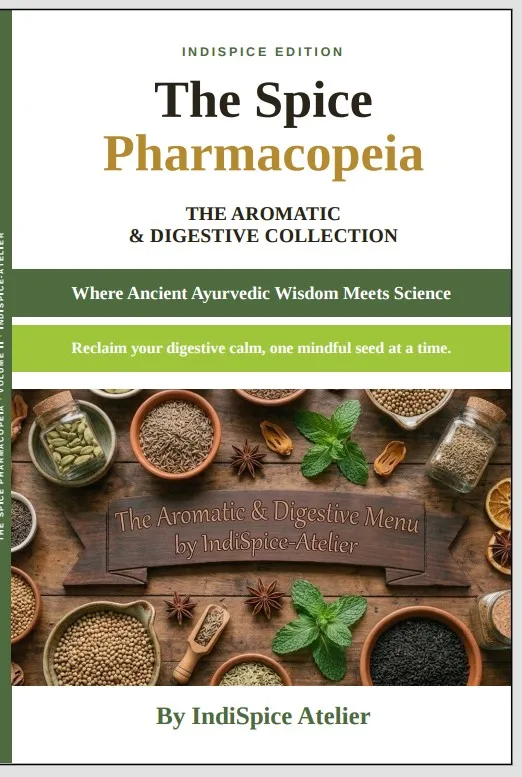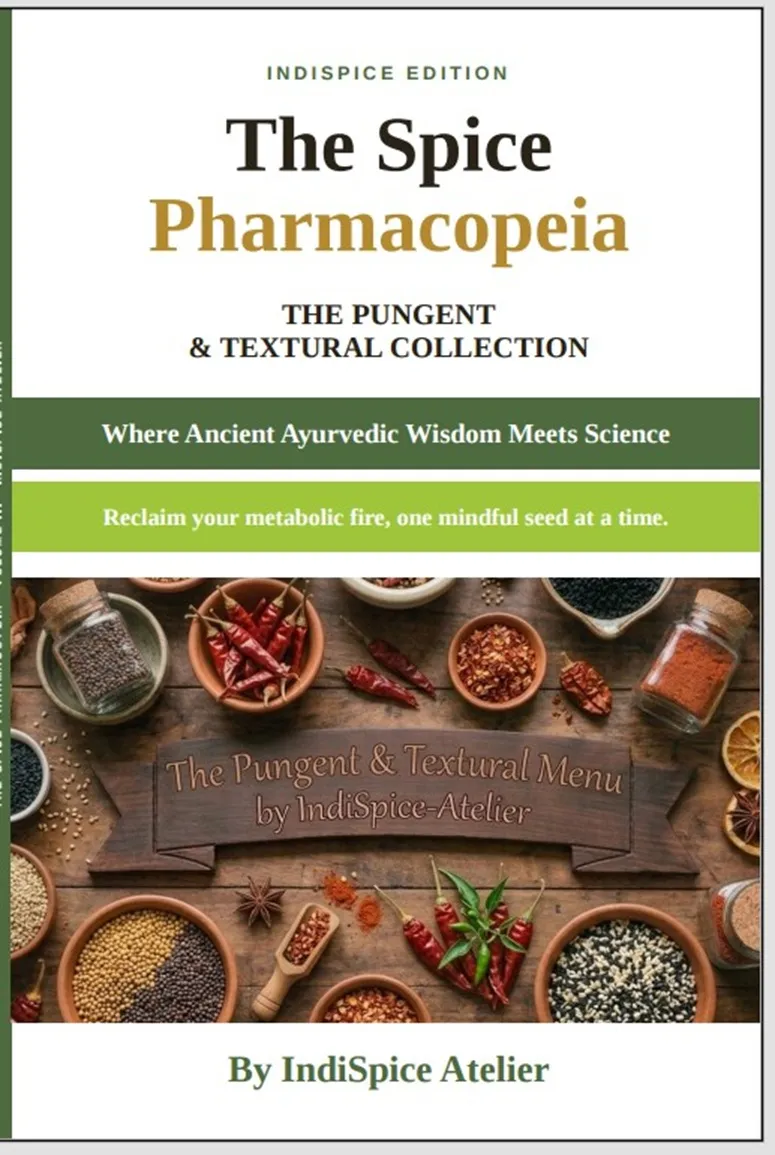
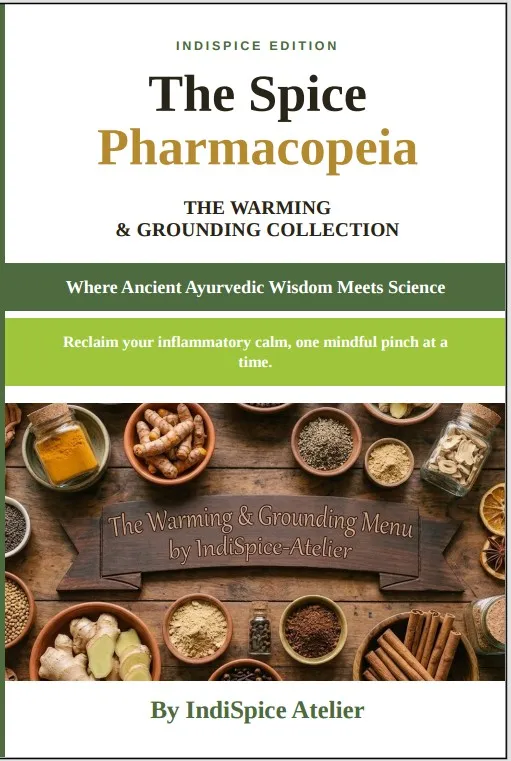
Kindle eBook · Available on Amazon
Volume I · The Spice Pharmacopeia
The Warming & Grounding Collection
Where ancestral wisdom meets modern science
Five everyday warming spices — turmeric, black pepper, ginger, clove and cinnamon — turned into a daily anti-inflammatory toolkit. Each is mapped from countertop quality test to Ayurvedic profile to peer-reviewed pharmacology, then built into Western-friendly recipes engineered for full bioavailability.
Kindle eBook · Available on Amazon
By IndiSpice Atelier. Researched against peer-reviewed pharmacology.
As an Amazon Associate, IndiSpice Atelier earns from qualifying purchases.
What you'll learn
- Master the turmeric–black-pepper–fat stack that raised curcumin absorption roughly 2,000% in the foundational trial (Shoba et al., Planta Medica, 1998).
- Tell true Ceylon cinnamon from coumarin-heavy Cassia — the single most consequential safety swap in the volume.
- Use ginger's gingerols and shogaols to speed gastric emptying and quiet nausea.
- Deploy clove's eugenol where the evidence is strongest: the mouth and the airways.
- Build a morning / midday / evening Warming & Grounding stack on a simple weekly rhythm.
- Read every claim against named 2023–2025 meta-analyses, with dosages and contraindications.
Inside this volume
Volume I of The Spice Pharmacopeia, by IndiSpice Atelier, covers five warming botanicals — turmeric (Curcuma longa), black pepper (Piper nigrum), ginger (Zingiber officinale), clove (Syzygium aromaticum) and Ceylon cinnamon (Cinnamomum verum) — profiling each across a ten-part framework from quality testing to Ayurvedic energetics to peer-reviewed pharmacology, with three Western-friendly recipes per spice.
Each spice is broken down the same way: a countertop quality test, its Ayurvedic profile (Rasa, Virya, Vipaka), a Lab Report against named studies, three recipes, and a synergy-and-safety matrix. Turmeric's curcumin acts as an NF-κB inhibitor — a 2024 umbrella review in the Journal of Herbal Medicine pooled 21 systematic reviews and found significant reductions in CRP, IL-6 and TNF-α. Black pepper's piperine reversibly inhibits the UGT and CYP3A4 enzymes that would otherwise flush curcumin out. Ceylon cinnamon's cinnamaldehyde mimics insulin at the receptor and inhibits glycation; a 2025 MDPI Diabetology meta-analysis of fourteen trials recorded a significant HbA1c reduction. Ginger's gingerols and shogaols accelerate gastric emptying and block 5-HT3 receptors, with a 2025 meta-analysis reporting an odds ratio of 0.41 against severe morning sickness. Clove's eugenol delivers broad-spectrum antimicrobial and local-anaesthetic activity, strongest at the mouth and airways.
The volume's central argument is that the modern Western body is starving not for nutrients but for bioavailability — and that the traditional Indian kitchen solved this centuries before it was named. Trikatu, garam masala and masala chai read, under a modern lens, as deliberately designed pharmacokinetic stacks: bloom the spice in fat, finish with pepper, and never separate curcumin from its molecular partners.
A taste of the kitchen
A few recipes from the book
Ingredients shown without quantities — the full, optimised recipes are in Volume I.
The Cellular-Recovery Golden Porridge
A warm, grounding breakfast optimised for curcumin uptake.
Ingredients
- Rolled oats
- Milk of choice
- Ghee or cold-pressed coconut oil
- Turmeric
- Freshly cracked black pepper
- Ginger
- Ceylon cinnamon
- Maple syrup or raw honey
Method
- Bloom turmeric and cracked pepper in melted ghee for 30 seconds, until the oil turns vivid orange.
- Stir in oats to coat, then add milk, ginger and cinnamon.
- Simmer 5–7 minutes until creamy.
- Off the heat, sweeten with maple syrup or raw honey.
The Trikatu Morning Honey-Lemon Shot
The classical three-pungent formula as a small morning ritual.
Ingredients
- Body-temperature water
- Black pepper
- Long pepper (or extra black pepper)
- Dry ginger
- Raw honey
- Lemon
Method
- Warm the water to body temperature — never hot.
- Stir in the three pungent spices.
- Add raw honey and a squeeze of lemon.
- Sip slowly on an empty stomach, 15–20 minutes before breakfast.
The Prokinetic Ginger-Lemon Elixir
A fiery, sweet infusion to wake the digestive enzymes and ease bloating.
Ingredients
- Fresh ginger root
- Filtered water
- Lemon
- Raw honey
- Sea salt
Method
- Smash a knob of fresh ginger to expose the gingerols.
- Simmer in water for 15 minutes with a tight lid to trap the volatile oils.
- Cool to lukewarm, then add lemon, raw honey and a pinch of salt.
- Sip before a heavy meal.
Why this volume matters
Chronic, low-grade inflammation is now understood as the shared substrate beneath cardiovascular disease, type 2 diabetes, neurodegeneration and accelerated aging. Anything that meaningfully lowers inflammatory signalling, feeds the microbiome and improves the absorption of beneficial compounds is, in a literal sense, a longevity intervention.
That is what these five spices do — not as folk wisdom, but as a coherent, food-based response to a documented modern crisis. You do not need exotic supplements or a new diet; the tools are already on your counter.
Volume I is not about adding spices to your kitchen. It is about returning your kitchen to itself.
Bring the apothecary back to your kitchen.
As an Amazon Associate, IndiSpice Atelier earns from qualifying purchases.
Frequently asked
Questions about Volume I
What is The Spice Pharmacopeia Volume I about?+
Volume I — The Warming & Grounding Collection — profiles five everyday warming spices (turmeric, black pepper, ginger, clove and Ceylon cinnamon) across a ten-part framework, pairing classical Ayurvedic energetics with peer-reviewed pharmacology and three Western-friendly recipes per spice.
Which spices does Volume I cover?+
Turmeric (Haldi), Black Pepper (Kali Mirch), Ginger (Adrak), Clove (Laung) and Cinnamon (Dalchini) — with a strong emphasis on using true Ceylon cinnamon rather than Cassia.
Is Volume I suitable for beginners?+
Yes. Every spice starts with a simple countertop quality test and builds to accessible recipes; no special equipment, exotic ingredients or prior knowledge is required.
Do I need supplements, or just my kitchen?+
Just your kitchen. The book's core argument is that whole spices cooked correctly — bloomed in fat, finished with pepper — outperform poorly absorbed capsules. A clinical dosage reference is included for readers who do supplement.
What is the difference between Ceylon and Cassia cinnamon, and why does the book stress it?+
Most supermarket 'cinnamon' is Cassia, which is high in coumarin and can exceed the EFSA tolerable daily intake at everyday doses. True Ceylon cinnamon (Cinnamomum verum) contains only trace coumarin and is the safe choice for daily use — the book shows how to tell them apart.
From the kitchen
Cook and read alongside this volume
Recipe
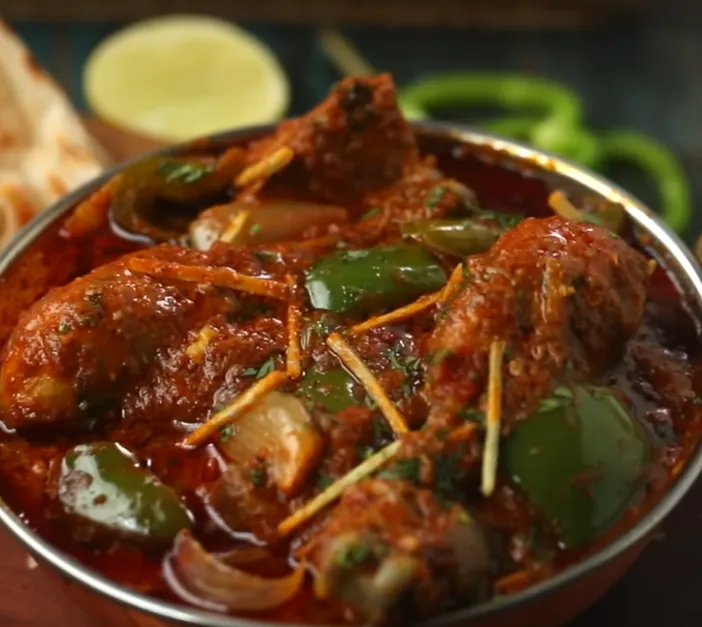
Chicken Kadhai
Chicken dish with Capsicum , Tomatoes, Green Chili and lots of fun!
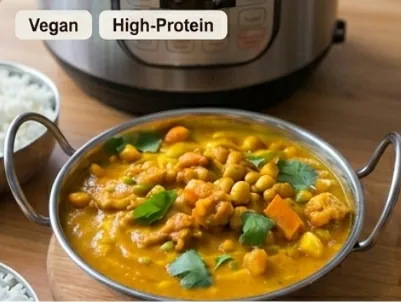
Vegan
Instant Pot Turmeric Chickpea Curry
A quick and easy vegan curry made in the Instant Pot with protein-rich chickpeas and aromatic turmeric.
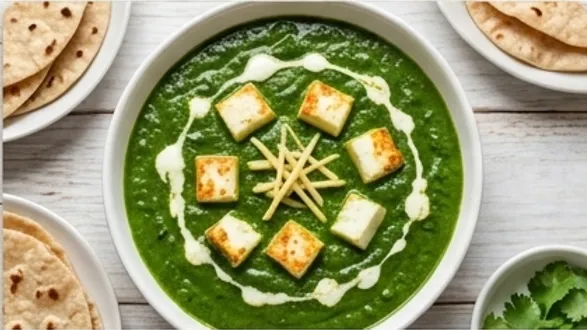
Vegetarian
Quick Weeknight Palak Paneer
A creamy spinach and cheese curry that's ready in just 35 minutes — perfect for busy weeknights.
New: Google now lets you choose which sites it shows you first. One tap lifts our spice guides in your results — nobody else's — and you can undo it any time.
Continue the series