Kindle eBook · Available on Amazon
Volume VI · The Spice Pharmacopeia
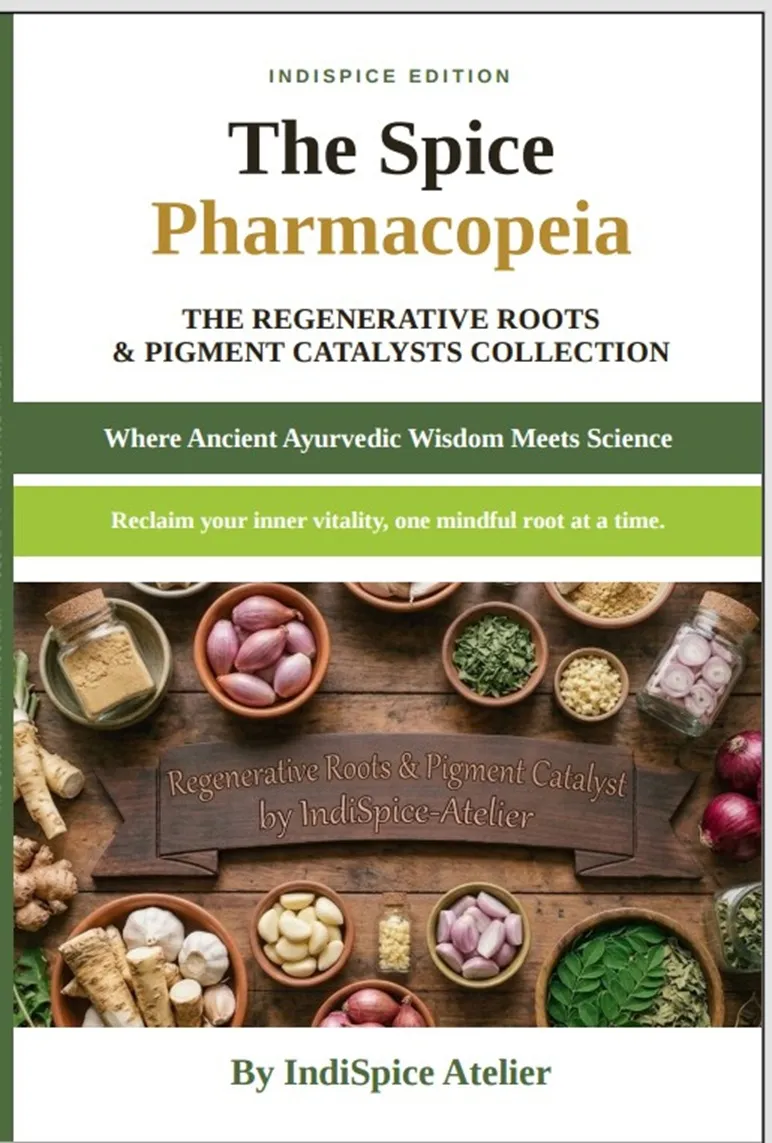
The Regenerative Roots & Pigment Catalysts Collection
Where ancestral wisdom meets modern science
Ginger, garlic, onion, shallot and horseradish — sulphur-rich roots that ignite metabolism, circulation and mitochondrial function.
Kindle eBook · Available on Amazon
By IndiSpice Atelier. Researched against peer-reviewed pharmacology.
As an Amazon Associate, IndiSpice Atelier earns from qualifying purchases.
What you'll learn
- Apply the 'crush and rest' correction — let crushed garlic sit 10 minutes before heat so allicin fully forms before the heat-sensitive enzyme is destroyed.
- Use dry ginger's shogaols for a sustained, deep thermal effect, and fresh ginger's gingerols for an immediate metabolic spark.
- Caramelise onions and shallots to convert their fructans into sweet prebiotic fuel for the gut microbiome.
- Trap horseradish's volatile AITC with a 'Volatile Vapour Lock' — suspending it in acid or fat before it evaporates.
- Pair each root for maximum effect: garlic with acid, ginger with fat, onion with vitamin C, horseradish with vinegar.
- Heed the safety calibrations: antiplatelet activity, the two-week pre-surgery rule, and GERD cautions.
Inside this volume
Volume VI of The Spice Pharmacopeia, by IndiSpice Atelier, covers five regenerative roots — fresh and dry ginger (Zingiber officinale), garlic (Allium sativum), onion and shallots (Allium cepa) and horseradish (Armoracia rusticana) — the sulphur-rich, subterranean catalysts that restore metabolic and mitochondrial spark.
Each root carries a precise technique. Garlic's allicin does not exist in the intact clove — it requires crushing to let alliinase act on alliin, and because that enzyme is heat-sensitive, the structural correction is to crush and rest for 10 minutes before any heat. Dry ginger's shogaols offer a sustained thermal effect that supports mitochondrial respiratory capacity via the electron transport chain, while fresh ginger's gingerols deliver the acute spark. Horseradish's primary bioactive, allyl isothiocyanate (AITC), is a highly unstable gas that must be suspended in acid or fat the moment the root is grated.
Onions and shallots anchor the gut: their fructans (prebiotic fibres) and quercetin fuel beneficial microbes while protecting the vascular lining. Paired correctly — garlic with acid, ginger with fat, onion with vitamin C, horseradish with vinegar — these roots become a cardiovascular and respiratory toolkit. The volume is clear on safety too: concentrated garlic and ginger have antiplatelet activity, so high-dose protocols should pause two weeks before surgery and be discussed with a physician by anyone on anticoagulants.
A taste of the kitchen
A few recipes from the book
Ingredients shown without quantities — the full, optimised recipes are in Volume VI.
The Allicin-Synthesised Cardiovascular Sweeper
The 'crush and rest' method for maximum allicin yield.
Ingredients
- Fresh garlic cloves
- Warm olive oil or a finished dish
Method
- Crush the peeled cloves with the flat of a blade to rupture the cells.
- Let them rest, undisturbed, for 10 minutes to complete allicin synthesis.
- Stir into warm oil or the finished dish at the end — never at high heat.
The Sunthi-Haldi Winter Regenerative Latte
Dry ginger 'thermally awakened' and emulsified with turmeric.
Ingredients
- Dry ginger (sunthi)
- Turmeric
- Black pepper
- Coconut milk
Method
- Gently toast grated dry ginger for ~10 seconds until the aroma deepens.
- Whisk into warm coconut milk with turmeric and black pepper.
- Sip warm to facilitate lipid-based transport of the actives.
The Horseradish AITC Volatile Emulsion
A 'Volatile Vapour Lock' that traps horseradish's unstable sting.
Ingredients
- Fresh horseradish root
- Chilled yogurt or apple cider vinegar
Method
- Finely grate the fresh horseradish.
- Cover immediately with a tight lid to trap the volatile AITC.
- Fold into chilled yogurt or vinegar to lock the sting into a liquid carrier.
Why this volume matters
Volume VI descends into the subterranean roots — the catalysts of metabolic ignition. In a landscape where convenience replaced the fresh rhizome and the crushed-and-rested clove with shelf-stable jars and powders whose volatile compounds have long vanished, this volume is about recovering the spark.
It closes the series where it began: accessibility as medicine. Reclaiming the piercing heat of fresh ginger, the sulphurous bite of properly prepared garlic and the prebiotic sweetness of slow-cooked onion is a daily, low-cost act of metabolic reclamation.
Bring the apothecary back to your kitchen.
As an Amazon Associate, IndiSpice Atelier earns from qualifying purchases.
Frequently asked
Questions about Volume VI
What is The Spice Pharmacopeia Volume VI about?+
Volume VI — The Regenerative Roots & Pigment Catalysts Collection — profiles five sulphur-rich roots (fresh and dry ginger, garlic, onion and shallots, and horseradish) that ignite metabolism, circulation and mitochondrial function, pairing Ayurvedic tradition with modern pharmacology.
Which roots does Volume VI cover?+
Fresh Ginger (Adrak), Dry Ginger (Sunthi), Garlic (Lahsun), Onion & Shallots (Pyaaz) and Horseradish (Sahjanmula).
Why crush garlic and let it rest before cooking?+
Allicin — garlic's key compound — only forms after the clove is crushed, and the enzyme that makes it is destroyed by heat. Resting crushed garlic for 10 minutes before heat lets the reaction complete. The book details the chemistry.
Are there safety cautions with these roots?+
Yes. Concentrated garlic and ginger have antiplatelet activity, so the volume advises discussing high-dose use with a physician if you take anticoagulants and pausing two weeks before surgery; fresh ginger and horseradish can also aggravate GERD. It is educational, not a substitute for medical advice.
Is Volume VI suitable for beginners?+
Yes. These are everyday roots, and the volume centres on simple, high-impact techniques — crush-and-rest garlic, caramelised onion, a winter ginger latte — with clear safety notes.
New: Google now lets you choose which sites it shows you first. One tap lifts our spice guides in your results — nobody else's — and you can undo it any time.
Continue the series