Kindle eBook · Available on Amazon
Volume IV · The Spice Pharmacopeia
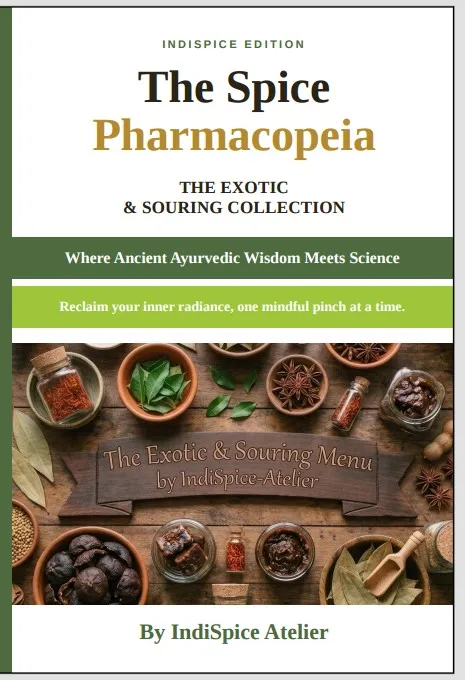
The Exotic & Souring Collection
Where ancestral wisdom meets modern science
Saffron, tamarind, kokum, bay leaf, curry leaf, star anise and asafoetida — precious aromatics and souring agents for mood and radiance.
Kindle eBook · Available on Amazon
By IndiSpice Atelier. Researched against peer-reviewed pharmacology.
As an Amazon Associate, IndiSpice Atelier earns from qualifying purchases.
What you'll learn
- Use saffron (Crocus sativus) as the collection's premier mood-supportive botanical, with a documented clinical signal for mild-to-moderate low mood.
- Cut through rich, heavy dishes with tamarind and kokum — souring agents that also support cardiometabolic balance.
- Tell true Indian bay leaf (Cinnamomum tamala) from Mediterranean Laurus nobilis — they are not interchangeable.
- Activate asafoetida (hing) in fat to tame Vata and relieve the cramping gut through antispasmodic smooth-muscle relaxation.
- Build curry leaf and star anise into daily aromatics that prepare the gut and senses for the more precious agents.
- Read the 'mood-and-radiance' case across Ayurvedic Rasa–Virya–Vipaka and modern pharmacology.
Inside this volume
Volume IV of The Spice Pharmacopeia, by IndiSpice Atelier, covers seven precious and souring botanicals — saffron (Crocus sativus), Indian bay leaf (Cinnamomum tamala), curry leaf (Murraya koenigii), star anise (Illicium verum), tamarind (Tamarindus indica), kokum (Garcinia indica) and asafoetida (Ferula asafoetida) — the high-register aromatics that restore the 'mood-and-radiance' register.
Saffron is the centrepiece — a mood-supportive botanical whose secondary metabolites act as agents of cognitive defence and, in the series' framework, the primary tool for 'elevating Ojas'. Around it sit the souring agents tamarind and kokum, which cut cloying richness and support cardiometabolic balance; the structural aromatics Indian bay leaf, curry leaf and star anise, which provide a daily metabolic and digestive baseline; and asafoetida (hing), the pungent resinous catalyst that tames Vata.
A technical calibration runs through the volume: Indian bay leaf (Cinnamomum tamala), defined by warm cinnamic aldehydes, is botanically and chemically distinct from the cineole-heavy Mediterranean Laurus nobilis — the two are not interchangeable. Hing, activated in a fat matrix, works as a digestive activator through antispasmodic smooth-muscle relaxation, relieving cramping and opening the olfactory pathway.
A taste of the kitchen
A few recipes from the book
Ingredients shown without quantities — the full, optimised recipes are in Volume IV.
The Radiant-Ojas Saffron Infusion
A simple saffron infusion for mood and cognitive support.
Ingredients
- Saffron threads
- Warm milk or water
- A little ghee or fat
Method
- Gently warm the milk or water with a little fat (saffron's compounds are fat-soluble).
- Steep a few saffron threads until the liquid turns golden.
- Sip slowly, warm.
The South Indian Sambar
A functional staple uniting curry leaf and tamarind.
Ingredients
- Tamarind
- Curry leaves
- Lentils
- Vegetables
- Tempering spices
Method
- Simmer lentils and vegetables in tamarind water.
- Prepare a tempering of curry leaves and aromatics in ghee.
- Stir the tempering through for cardiometabolic grounding.
The Vata-Shattering Ghee-Hing Catalyst
Asafoetida bloomed in ghee to settle digestive distress.
Ingredients
- Asafoetida (hing)
- Ghee
Method
- Warm the ghee gently.
- Add a pinch of hing and let it sizzle for a few seconds — the 'thermal awakening'.
- Stir into dals or vegetables to ease gas and cramping.
Why this volume matters
The 'modern radiance deficit' — cognitive fatigue, low mood, a loss of internal lustre — is the quiet crisis this volume addresses. These are not everyday finishers; they are precious, regionally specific botanicals that operate on a higher physiological register, building the chemical scaffolding for emotional and structural steadiness.
It is also the volume where honest calibration matters most: knowing your bay leaf, respecting saffron's potency, and using hing with precision. The book draws those lines clearly so the kitchen stays both effective and safe.
Bring the apothecary back to your kitchen.
As an Amazon Associate, IndiSpice Atelier earns from qualifying purchases.
Frequently asked
Questions about Volume IV
What is The Spice Pharmacopeia Volume IV about?+
Volume IV — The Exotic & Souring Collection — profiles seven precious and souring botanicals (saffron, Indian bay leaf, curry leaf, star anise, tamarind, kokum and asafoetida) that support mood, radiance and digestion, pairing Ayurvedic tradition with modern pharmacology.
Which spices does Volume IV cover?+
Saffron (Kesar), Indian Bay Leaf (Tej Patta), Curry Leaf (Kadi Patta), Star Anise (Chakra Phool), Tamarind (Imli), Kokum (Amsul) and Asafoetida (Hing).
Is saffron really good for mood?+
Saffron carries a documented clinical signal for mild-to-moderate low mood, and the volume presents it within that evidence — as a supportive botanical, not a treatment. The book is educational and not a substitute for medical care.
What is the difference between Indian bay leaf and regular bay leaf?+
Indian bay leaf (Cinnamomum tamala) has a warm, cinnamon-bark profile, while Mediterranean bay (Laurus nobilis) is eucalyptus-like and cineole-heavy. They are chemically distinct and not interchangeable — the book explains why it matters.
Is Volume IV suitable for beginners?+
Yes, though these are more 'special-occasion' botanicals. The volume gives clear sourcing and dosing guidance so beginners can use even saffron and hing with confidence.
New: Google now lets you choose which sites it shows you first. One tap lifts our spice guides in your results — nobody else's — and you can undo it any time.
Continue the series