
Ingredients
Millet vs Rice vs Quinoa: Glycemic Index Compared
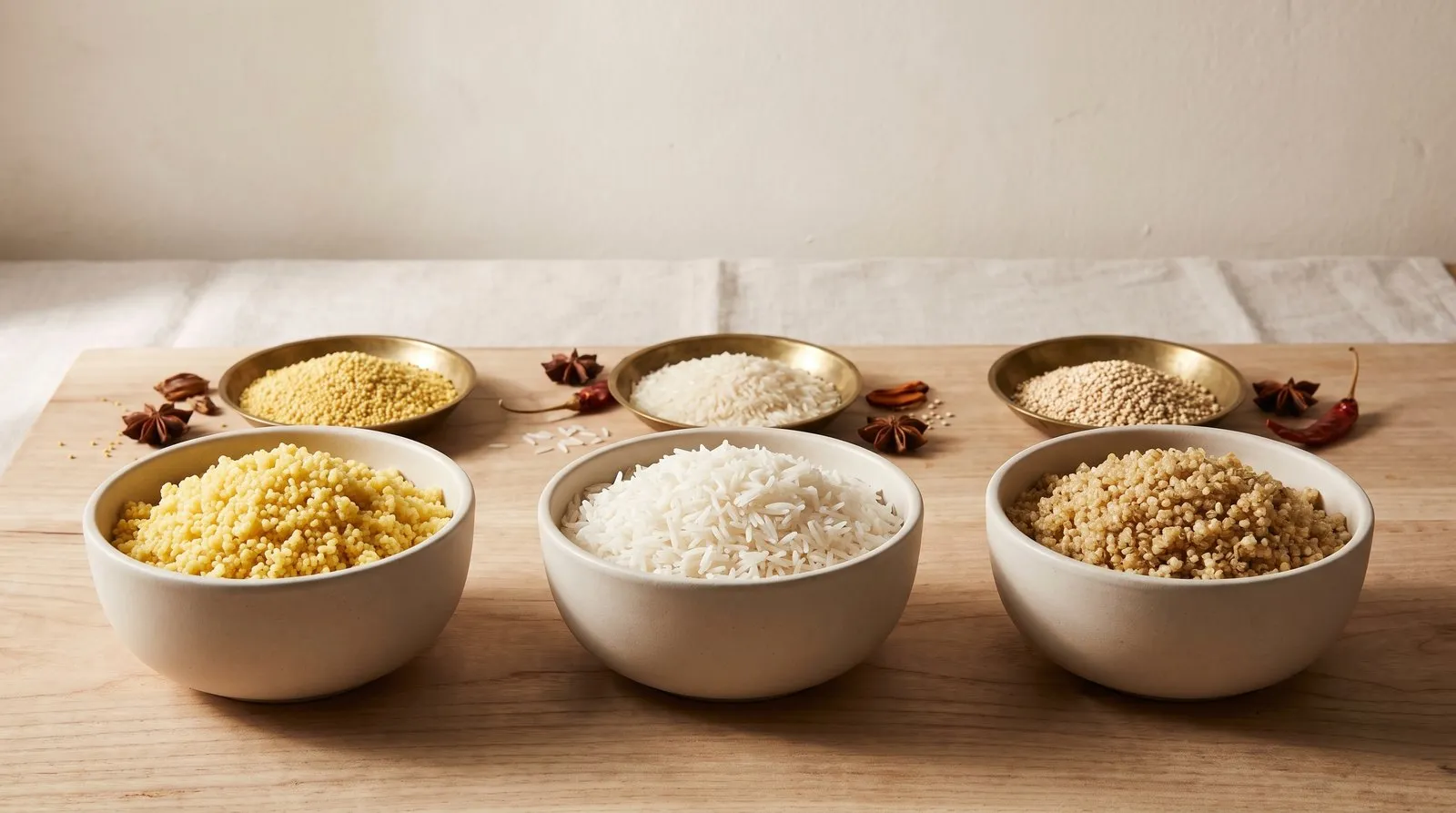
Quick answer
Millets and quinoa are both low-GI on average, at about 53. Ordinary white rice is high, at about 73.
But the grain is only half the story. How it was processed (whole, flour or puffed), how it was cooked, and how much you eat move the number as much as the choice of grain does.
- Best everyday choices: whole-grain millets (foxtail, barnyard, little, kodo), quinoa, and parboiled or aged basmati rice.
- Watch out for: sticky short-grain white rice, finely milled millet flour, and anything puffed, flaked or instant.
- Whatever you choose: about ¾ cup cooked, one quarter of the plate, with dal, vegetables or yogurt beside it.
GI and GL in one minute
Glycemic index (GI) is how fast the carbohydrate in a food raises blood sugar, compared with pure glucose, which scores 100.
- Low: 55 or under
- Medium: 56 to 69
- High: 70 or over
Glycemic load (GL) also counts how much you eat. A big bowl of a medium-GI grain can raise blood sugar more than a small bowl of a high-GI one. That is why portion size comes up again and again on this page.
The comparison table
GI values vary between studies, varieties and cooking methods, so read these as typical ranges, not exact scores.
| Grain (cooked) | Typical GI | Band |
|---|---|---|
| White rice (regular) | about 73 | High |
| Refined wheat (white bread, maida) | about 74 | High |
| White basmati rice | about 50–65 (average near 60) | Low to medium |
| Brown rice | about 50–68 (studies disagree) | Low to medium |
| Parboiled rice | usually lower than regular white rice | Low to medium |
| Quinoa | about 53 | Low |
| Millets (average of many studies) | about 53 | Low |
Sources: the international GI tables (Atkinson et al., 2021) and a systematic review of 65 human studies on millets (Anitha et al., 2021). The millet review put the average millet GI at 52.7, against 71.7 for refined white rice and 74.2 for refined wheat.
What is in a cooked cup
GI is not the only difference. Protein and fibre both slow down how fast a meal reaches your blood.
| One cup, cooked | Carbohydrate | Protein | Fibre |
|---|---|---|---|
| White rice | about 45 g | about 4 g | under 1 g |
| Brown rice | about 45 g | about 5 g | about 3 g |
| Millet (proso, USDA) | about 41 g | about 6 g | about 2 g |
| Quinoa | about 39 g | about 8 g | about 5 g |
Approximate values from USDA FoodData Central. Brands and varieties differ.
Quinoa wins on protein and fibre. Millet wins on price, variety and taste in Indian cooking. White rice loses on both counts, but it can still fit, as shown below.
Millets, one by one
“Millet” is not one grain. It is a family of small-seeded grasses that have fed India and Africa for thousands of years. All of them are naturally gluten-free. In the review above, foxtail and barnyard millet were among those with the lowest average GI.
| Millet | Indian names | Taste and texture | Best for |
|---|---|---|---|
| Foxtail | kangni, thinai, korra | Light, slightly nutty; fluffy like rice | Pulao, lemon “rice”, bowls |
| Barnyard | sanwa, sama, kuthiravali | Soft, mild | Khichdi, upma, a rice swap |
| Little | kutki, samai | Delicate, quick-cooking | Pongal, curd “rice” |
| Kodo | kodra, varagu | Earthy, firmer grain | Pulao, salads |
| Finger | ragi, nachni | Deep, malty; usually a flour | Dosa, roti, porridge |
| Pearl | bajra, kambu | Robust, grassy | Roti, winter khichdi |
| Sorghum | jowar, cholam | Mild, wheat-like | Roti, salads |
Processing changes everything
The same millet can be low-GI or high-GI depending on what happened to it before it reached your plate.
- Whole grain beats flour. A whole cooked grain digests more slowly than the same grain ground to flour.
- Coarse beats fine. In one study, finger millet roti made from stone-ground flour had a GI of about 44. The same roti from industrially milled flour scored about 59 (milling study).
- Roasted, puffed and flaked are fastest. Roasted finger millet flour has measured above 70, in the same band as white rice.
The rule: cook millets as whole grains most of the time. When you use millet flour, choose stone-ground. Treat millet puffs, flakes and instant mixes as treats, not staples.
Millet and your thyroid
Pearl millet (bajra) and sorghum (jowar) contain goitrogens, natural compounds that can interfere with how the thyroid uses iodine. Cooking destroys most of them, and normal meal amounts are not a problem for most people. If you have a thyroid condition, favour foxtail, barnyard, little and finger millet, and mention millets to your doctor.
Quinoa vs rice
If you are choosing between quinoa and rice for blood sugar, quinoa is the stronger choice: lower GI, about twice the protein and several times the fibre of white rice. It cooks in 15 minutes and works anywhere you would use rice.
Its downsides are cost and taste. Quinoa costs several times more than rice or millet, and it tastes slightly grassy. If you cook Indian food, foxtail or barnyard millet gives you a similar GI at a lower price, with a flavour that suits a pulao or a khichdi.
Millet vs quinoa
They are closer than most comparisons suggest. Both average a GI near 53. Quinoa has a little more protein and fibre per cup. Millets are cheaper, come in more varieties, and are traditional in Indian cooking. Choose whichever you will actually eat. The best low-GI grain is the one that replaces white rice on your plate most days.
How to eat rice without the spike
You do not have to give up rice. Four changes make it work much better.
- Choose the variety. Aged basmati and parboiled rice usually have a lower GI than sticky short-grain white rice.
- Measure it. About ¾ cup cooked, one quarter of the plate.
- Never let it arrive alone. Eat the dal, vegetables and yogurt first, and the rice last.
- Try cook, cool, reheat. Cooling cooked rice in the fridge for 12 to 24 hours turns part of its starch into resistant starch, which digests more slowly. One small study found a lower blood sugar response to cooked, chilled and reheated white rice (Sonia et al., 2015). Cool the rice quickly and keep it cold, because cooked rice left warm can grow harmful bacteria.
How to cook millet
There is no single correct amount of water. Millets from different farms, mills and brands absorb water differently. Treat these figures as a starting point, and expect your first pot from each new bag to be a small experiment.
- Rinse the millet in a sieve until the water runs almost clear.
- Soak for 2 to 4 hours. This is the most common practice. The grain cooks more evenly and turns fluffier. Drain the soaking water.
- Start with this much water for 1 cup of soaked millet: about 1½ cups for foxtail, barnyard or little millet (simmer on low 12 to 15 minutes), or about 1¾ cups for kodo (15 to 18 minutes). Then rest 10 minutes with the lid on.
- Adjust next time. Mushy? Use about ¼ cup less water. Hard in the middle? Use about ¼ cup more, or soak longer. Write the answer on the bag.
Cook it, don’t just read about it
Spice Against the Sugar Spike has a full millet chapter: foxtail millet pulao, barnyard millet khichdi, lemon millet, jowar roti, ragi dosa and more, each with a starting water amount and a portion size. It is part of 57 Indian recipes built to keep blood sugar steadier. For how the grain fits on the plate, see the plate method, the Indian way. For a week of low-GI meals with millet in them, see our PCOS meal plan.
This page is for general information and is not medical advice. If you have diabetes or prediabetes, or take medicine for blood sugar, talk to your doctor or a registered dietitian before you make big changes to your diet.
Sources: Atkinson F.S. et al. (2021), International tables of glycemic index and glycemic load values 2021, American Journal of Clinical Nutrition 114(5):1625–1632 · Anitha S. et al. (2021), A systematic review and meta-analysis of the potential of millets for managing and reducing the risk of developing diabetes mellitus, Frontiers in Nutrition 8:687428 · Sonia S. et al. (2015), Effect of cooling of cooked white rice on resistant starch content and glycemic response, Asia Pacific Journal of Clinical Nutrition 24(4):620–625 · USDA FoodData Central.
Common questions
Which has the lowest glycemic index: millet, rice or quinoa?+
On average, millets and quinoa are both low-GI, at about 53, and regular white rice is high, at about 73. But the average hides a lot. Some millets score in the 40s and some millet products score above 70, depending on the variety and how the grain was processed. Basmati and parboiled rice usually sit well below ordinary white rice. The way a grain is processed and cooked, and how much of it you eat, matter as much as which grain it is.
What is the glycemic index of quinoa?+
Cooked quinoa has a GI of about 53 in the international GI tables, which puts it in the low band (55 or under). It also carries about twice the protein and several times the fibre of white rice per cooked cup, which is part of why it tends to raise blood sugar more gently.
Is millet good for diabetics?+
Millets can be a good choice. A 2021 review of human studies found an average GI of about 53 for millets, against about 72 for refined white rice, and people with diabetes who ate millets as a staple had lower fasting and after-meal blood sugar. That does not make millet a treatment. Portion size still matters, whole grains beat flours and puffed products, and anyone on diabetes medicine should talk to their doctor before making big diet changes.
Is brown rice lower GI than white rice?+
Usually, but by less than people expect. Brown rice studies range from about 50 to 68, so it is typically low to medium GI, against about 73 for ordinary white rice. Its bigger advantage is fibre: about three grams per cooked cup, against well under one gram for white rice.
What is the glycemic index of basmati rice?+
White basmati usually measures between about 50 and 65, with an average near 60. That is medium GI, and well below sticky short-grain white rice. Aged, long-grain basmati tends to sit at the lower end.
Does cooling rice lower its glycemic index?+
It may lower it a little. Cooling cooked rice in the fridge for 12 to 24 hours turns part of its starch into resistant starch, which digests more slowly. One small study found a lower blood sugar response to cooked, chilled and reheated white rice. Cool the rice quickly and keep it cold, because cooked rice left warm can grow bacteria that reheating does not make safe.
Do millets affect the thyroid?+
Pearl millet (bajra) and sorghum (jowar) contain goitrogens, natural compounds that can interfere with how the thyroid uses iodine. Cooking destroys most of them, and normal meal amounts are not a problem for most people. If you have a thyroid condition, favour foxtail, barnyard, little and finger millet, and mention millets to your doctor.
New: Google now lets you choose which sites it shows you first. One tap lifts our spice guides in your results — nobody else's — and you can undo it any time.