Technique
PCOS Diet Plan: A Low-GI 7-Day Meal Plan Backed by a Clinical Trial
Quick answer
A good PCOS diet plan keeps blood sugar and insulin from spiking. In practice:
- Choose low-GI carbohydrates. Dal, beans, millets, oats and basmati or parboiled rice in place of white bread, sticky white rice and sugary cereal.
- Build every meal as a plate. Half non-starchy vegetables, a quarter protein, a quarter slow carbohydrate.
- Eat protein at every meal, breakfast included.
- Stop drinking sugar. Juice, soda, sweet chai and sweet lassi.
In a 12-month clinical trial, women with PCOS who ate this way improved insulin sensitivity about three times more than women on a matched “healthy” diet. Among the women who finished and had irregular periods, 95% became more regular, compared with 63% on the other diet (Marsh et al., 2010).
Below: what that trial did, what it cannot tell you, a 7-day vegetarian meal plan, and the answers to “can I eat roti?” and “is upma OK?”.
Why blood sugar matters in PCOS
Polycystic ovary syndrome (PCOS) affects an estimated 6–13% of women of reproductive age (WHO). You may also see it called PMOS, a newer name some hospitals now use. It is the same condition.
Most women with PCOS have insulin resistance, whatever their weight. Their cells respond less to insulin, so the body makes extra. That extra insulin pushes the ovaries to make more androgens (male-type hormones), which drive irregular periods, acne and unwanted hair. It also raises the long-term risk of type 2 diabetes.
A meal that sends blood sugar up fast calls for a big burst of insulin. A meal that raises it slowly calls for less. That is the whole logic of a low-GI PCOS diet.
GI (glycemic index) ranks carbohydrate foods by how fast they raise blood sugar compared with pure glucose. 55 or below is low; 70 or above is high.
What the 2010 clinical trial found
Researchers at the University of Sydney ran the first trial to test a low-GI diet specifically in PCOS (Marsh, Steinbeck, Atkinson, Petocz and Brand-Miller, American Journal of Clinical Nutrition, 2010).
What they did
- 96 women with PCOS, aged 18 to 40, all overweight or obese.
- Two diets with the same calories, protein, fat, carbohydrate and fibre. The only difference was the type of carbohydrate: low-GI or moderate-to-high-GI.
- A dietitian supported every woman for up to 12 months, or until she lost 7% of her body weight.
What they found, among the 49 women who finished
| Outcome | Low-GI | Standard |
|---|---|---|
| Insulin sensitivity gain | 2.2 | 0.7 |
| Irregular periods that became more regular | 95% | 63% |
| Weight lost | 5.2% | 4.2% |
| Fibrinogen (a clotting protein linked to heart risk) | fell | rose |
| Emotional well-being | improved more | improved |
“Standard” is the conventional healthy diet. The weight difference was not significant.
The weight loss was similar in both groups. So the better results were not just from losing more weight. The type of carbohydrate seemed to matter by itself.
Cholesterol, testosterone and the other hormones changed about the same on both diets.
The detail that surprises people
The “conventional” diet was not junk food. It was the standard advice: high-fibre, whole-grain, low-fat. One of its swaps was brown rice and bran flakes, which most people would call healthy.
The researchers’ point: whole grain does not always mean low GI. Some whole-grain foods still raise blood sugar quickly. What counts is how the food behaves in your body, not just the word “whole” on the packet.
What this study cannot tell you
One trial is not the last word, and this one had real limits. The authors list them themselves:
- About half the women dropped out (49%), and those who left were heavier and more insulin resistant. The results may not hold for the most severe PCOS.
- The women were assigned in turn, not at random, and the dietitian knew who was on which diet.
- It was small. 49 women finished, 29 on one diet and 20 on the other.
- Food companies donated some of the food for both diets, and two authors had co-written a book on low-GI eating for PCOS.
- Women planning a pregnancy were not included, so it says nothing about fertility treatment.
Later work has pointed the same way. A 2013 trial found that a low-GI diet improved insulin sensitivity in women with PCOS even with calories held equal (Barr et al.), and a 2021 review of the trials reached a similar view (Saadati et al.). But none of this makes a low-GI diet a treatment. It is a sensible way to eat with PCOS, with good early evidence behind it.
Your PCOS plate, the Indian way
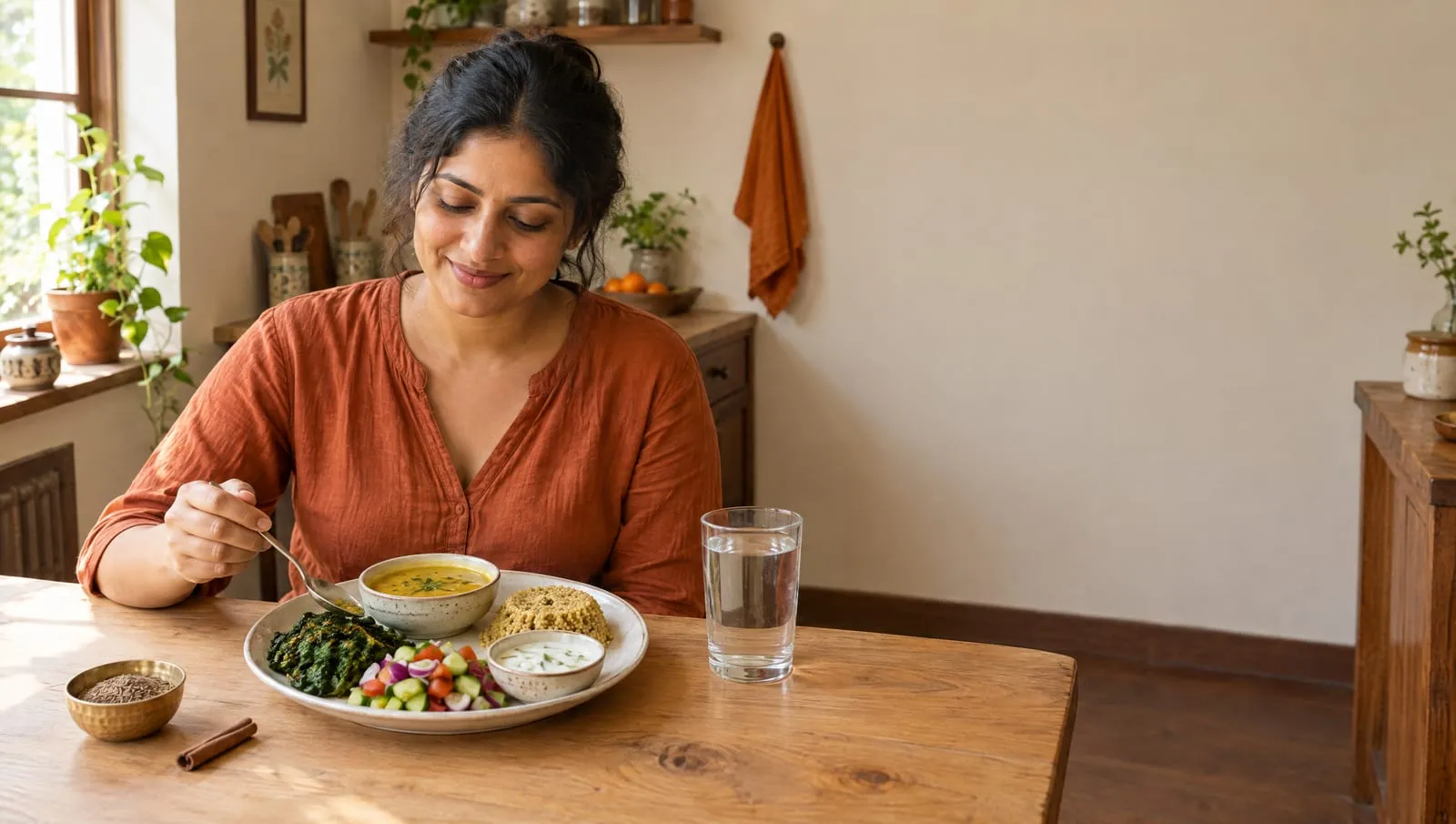
You do not need special foods. You need the same plate the American Diabetes Association teaches, which Indian home cooking suits well. More on it in the plate method, the Indian way.
- Half the plate: non-starchy vegetables. Spinach, cabbage, okra, beans, cauliflower, bottle gourd, a kachumber salad.
- A quarter: protein. Dal, rajma, chole, paneer, tofu, yogurt, eggs, chicken or fish.
- A quarter: a slow carbohydrate. About ¾ cup of cooked millet, basmati or parboiled rice, or one or two rotis.
- Eat the vegetables and dal first, and the rice or roti last. In a small study, the same meal raised blood sugar less when the carbohydrate came last (Shukla et al., 2015).
PCOS foods to eat and foods to limit
| Eat more | Limit |
|---|---|
| Dal, rajma, chole, moong, masoor | White bread, maida, naan |
| Millets: foxtail, barnyard, jowar, ragi | Large portions of sticky white rice |
| Basmati or parboiled rice, in a measured portion | Sugary breakfast cereals and instant oats |
| Steel-cut or rolled oats | Juice, soda, sweet chai, sweet lassi |
| Apples, pears, oranges, berries, guava | Mithai, biscuits, cakes |
| Paneer, yogurt, eggs, tofu, fish | Fried snacks: samosa, pakora, namkeen |
| Nuts and seeds | Rava (semolina) dishes eaten on their own |
You do not have to give up rice. Our millet vs rice vs quinoa guide compares the GI of each grain.
7-day PCOS meal plan (vegetarian, or with meat and fish)
Every meal pairs a slow carbohydrate with protein and vegetables. Drink water, unsweetened chai or masala chaas (thin spiced buttermilk).
The base plan is vegetarian. If you eat meat, eggs or fish, use the swap line under each day. Lean chicken, eggs and fish (salmon, cod, tuna or sardines, about twice a week) all fit a low-GI plate. Keep processed meats such as bacon, sausages and deli meats for rare occasions.
Want more choice at breakfast? See our 10 low-GI PCOS breakfast ideas.
Day 1
- Breakfast: Moong dal chilla with paneer and mint chutney
- Lunch: Foxtail millet pulao, rajma, cucumber raita
- Snack: Roasted chana and an apple
- Dinner: Palak paneer, cabbage thoran, one whole-wheat roti
- With meat or fish: a two-egg masala omelette for breakfast, and chicken palak in place of palak paneer
Day 2
- Breakfast: Vegetable oats upma with peanuts
- Lunch: Basmati rice (¾ cup), masoor dal, bhindi sabzi, kachumber
- Snack: Plain yogurt with a few walnuts
- Dinner: Chole, cauliflower sabzi, one missi roti
- With meat or fish: plain or Greek yogurt for the snack, and a chicken curry in place of the chole
Day 3
- Breakfast: Besan chilla with grated vegetables, plain yogurt
- Lunch: Jowar roti, mixed dal, lauki sabzi, salad
- Snack: Masala chaas and a pear
- Dinner: Paneer bhurji, sautéed beans, small bowl of barnyard millet
- With meat or fish: egg bhurji (spiced scrambled eggs) for breakfast, and grilled fish with the beans and millet
Day 4
- Breakfast: Steel-cut oats cooked in milk with cinnamon and berries
- Lunch: Barnyard millet khichdi with vegetables, raita
- Snack: Sprouted moong chaat
- Dinner: Tofu or paneer tikka, mint chutney, grilled vegetables, one roti
- With meat or fish: chicken tikka in place of the tofu or paneer
Day 5
- Breakfast: Ragi dosa with sambar
- Lunch: Chana dal, spinach sabzi, ¾ cup parboiled rice
- Snack: Guava and a few almonds
- Dinner: Rajma, vegetable raita, one jowar roti
- With meat or fish: a salmon or cod curry with the spinach and rice at lunch
Day 6
- Breakfast: Paneer and vegetable stuffed roti (one), yogurt
- Lunch: Quinoa or millet salad with chickpeas and lemon
- Snack: Roasted makhana
- Dinner: Vegetable dal tadka, baingan bharta, one roti
- With meat or fish: grilled chicken or tuna added to the quinoa salad at lunch
Day 7
- Breakfast: Masala omelette or tofu scramble, one slice whole-grain toast
- Lunch: Moong dal khichdi with vegetables, kadhi
- Snack: Hummus with carrot and cucumber
- Dinner: Kadai paneer, mixed vegetable salad, small bowl of millet
- With meat or fish: kadai chicken in place of kadai paneer
Portions are for you to set. Your needs depend on your size, activity and medicine. A registered dietitian can tailor the amounts.
Can I eat roti with PCOS?
Yes. A whole-wheat roti is a medium-GI food. What matters is how many and what comes with it.
- One or two rotis with dal, a vegetable and yogurt is a balanced plate.
- Four rotis with a little sabzi is mostly fast carbohydrate.
- Mix the flour. Add besan (chickpea flour) to the atta for missi roti, or use jowar or bajra flour. Both raise blood sugar more slowly than plain wheat.
Is upma good for PCOS?
Classic rava upma is made from refined semolina, which raises blood sugar fairly fast. Change the base and it fits:
- Make it with oats, broken wheat (dalia) or a millet instead of rava.
- Add a lot of vegetables: peas, carrots, beans, onion.
- Add protein: peanuts in the tempering, or a bowl of yogurt on the side.
Spices: flavour, not a cure
Spices are what make a low-GI plate taste like a meal and not a diet. That is the main reason to use them.
- Cinnamon sweetens oats and chai without sugar. It has a few small, early studies in PCOS. None is strong enough to call it a treatment. See our cinnamon guide.
- Cumin, coriander and turmeric carry dal, sabzi and khichdi. See cumin and turmeric.
- Fenugreek (methi) leaves and seeds suit dal, thepla and sabzi.
No spice treats PCOS. If you take medicine, ask your doctor before you start any daily spice supplement.
Sweetness without the spike
Sugar you drink reaches your blood fastest of all. Make chai with the spices and no sugar. If you need sweetness while your taste adjusts, a few drops of pure stevia do not raise blood sugar. See stevia for diabetics for which kind to buy.
Want the recipes?
Spice Against the Sugar Spike turns this meal plan into dinner: 57 Indian, spice-forward recipes built on the low-GI plate, a full millet chapter, high-protein breakfasts, and a 28-day plan with batch-cooking days. Every recipe has a vegetarian swap, and every spice claim carries an honest evidence label. It was written for steadier blood sugar, which is the same goal as a PCOS diet plan. It is not a PCOS treatment, and it does not promise a cure.
For the wider picture of eating for insulin resistance, read our prediabetes diet guide.
This page is general information, not medical advice. PCOS needs a doctor’s care. Talk to your doctor or a registered dietitian before you change your diet, especially if you take medicine such as metformin, or are pregnant or trying to conceive.
Common questions
What is the best diet plan for PCOS?+
There is no single best diet for PCOS, but the pattern with the most support is a balanced plate built on low-GI carbohydrates: plenty of non-starchy vegetables, protein at every meal, and grains, beans and fruit that raise blood sugar slowly. In a 12-month trial, women with PCOS on a low-GI diet improved insulin sensitivity about three times more than women on a matched conventional healthy diet, with similar weight loss. It is a way of eating, not a cure.
What does a PCOS meal plan look like for one day?+
A simple day might be moong dal chilla with paneer for breakfast; a measured portion of millet or basmati with rajma, a vegetable sabzi and raita for lunch; roasted chana and a pear in the afternoon; and a dal or paneer dish with two vegetables and one roti for dinner. If you eat meat or fish, eggs at breakfast and chicken or fish at lunch or dinner fit the same plate. Each meal pairs a slow carbohydrate with protein and vegetables, and sugar you drink is left out.
Can I eat roti with PCOS?+
Yes. A whole-wheat roti is a medium-GI food, and how it lands depends on what you eat with it and how many you eat. One or two rotis with dal, a vegetable and yogurt is a very different meal from four rotis on their own. Mixing besan or millet flour into the atta, as in missi roti or a jowar roti, lowers the blood-sugar rise further.
Is upma good for PCOS?+
Classic rava upma is made from refined semolina, which raises blood sugar fairly fast. Make it with oats, broken wheat or a millet instead, load it with vegetables, and add peanuts or a side of yogurt for protein. That version fits a PCOS meal plan well.
Can diet cure PCOS?+
No. PCOS is a lifelong condition, and no diet cures it. What food can do is improve the insulin resistance that drives many of its symptoms, and in trials that has meant better insulin sensitivity and, for many women, more regular periods. Your doctor still needs to be part of the plan, especially if you take medicine or are trying to get pregnant.
Do I have to lose weight for a low-GI diet to help PCOS?+
In the 2010 trial, both groups lost a similar, modest amount of weight, about 4 to 5% among the women who finished, yet the low-GI group improved insulin sensitivity three times more. So the type of carbohydrate seemed to matter on top of the weight lost. Weight loss still helps many women with PCOS, but the plate can help before the scale moves.
New: Google now lets you choose which sites it shows you first. One tap lifts our spice guides in your results — nobody else's — and you can undo it any time.