
Ingredients
How to Make Ghee at Home — and What 'Desi Ghee' Really Means
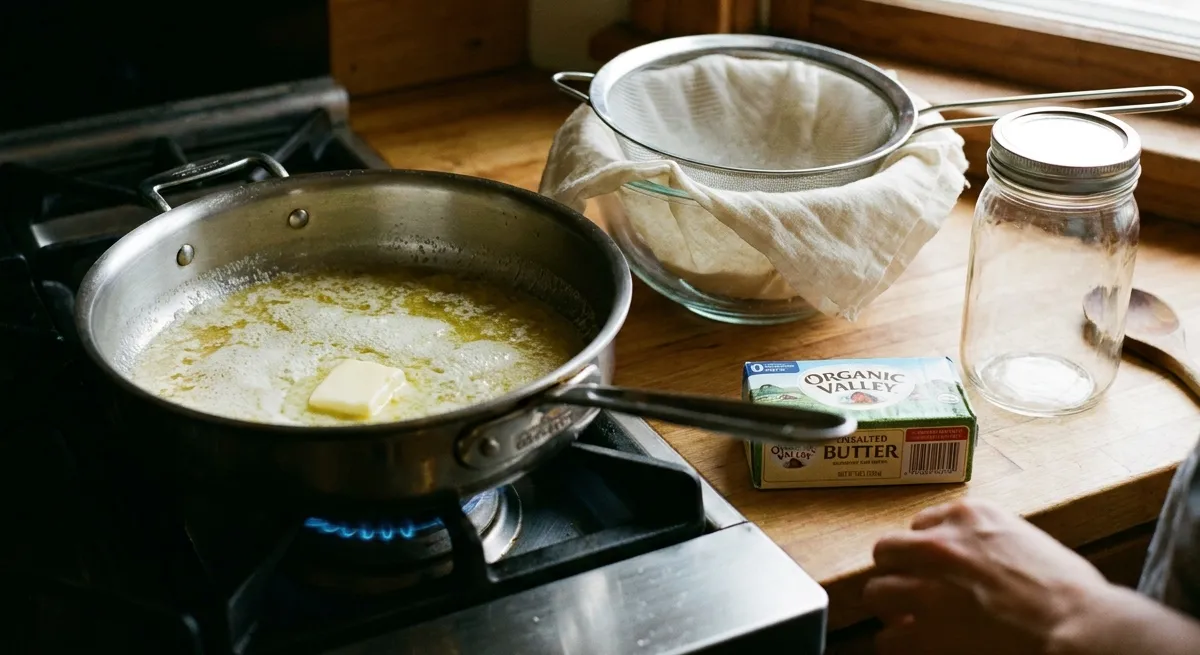
Quick answer
One ingredient. One pan. About half an hour.
Melt unsalted butter over medium-low heat, uncovered, and leave it alone. Then follow the sound:
- Loud sputtering — that is water boiling off.
- It quietens. The milk solids sink and start toasting on the bottom.
- It goes nearly silent, the sediment turns nut brown, and the smell changes from dairy to toasted. Strain immediately.
A pound of butter gives about a cup and a half of ghee.
The last stage takes under a minute, and there is no rescuing burnt ghee — so have the strainer, the cloth and a bone-dry jar ready before you start.
If you grew up with ghee and now live somewhere it is hard to buy, this page is the answer to that. Real desi ghee is expensive and inconsistent outside South Asia, and a lot of what is sold under that label in Western supermarkets is not what you remember.
You can make something better than most of it, from ordinary supermarket butter, in about half an hour.
What you need
- Unsalted butter. A pound is a sensible first batch. Two pounds is barely more work.
- A heavy-bottomed pan. Thin pans scorch the solids before the water has gone.
- A fine strainer, and muslin or cheesecloth to line it. A clean thin cotton cloth works.
- A completely dry glass jar with a lid. Dry is not optional — see below.
That is the whole list. There is no second ingredient.
Why unsalted: salt does not evaporate. All of it stays behind in a smaller volume of fat, so the ghee comes out noticeably salty and you have lost control of seasoning in everything you cook afterwards. Salted butter can also leave a cloudy sediment.
Cultured butter, if you can get it, gives a tangier and more complex result, closer to traditionally made Indian ghee. It is not necessary. Plain unsalted butter makes very good ghee.
The method
1. Melt it, medium-low, uncovered.
No lid, ever. The entire purpose is to let water escape, and a lid returns it to the pan.
2. Let it boil, and leave it alone.
Once melted it comes to a rolling, sputtering boil and throws up a layer of white foam. That noise is water leaving. This is the longest stage and it needs no attention — do not stir, do not skim, do not fiddle.
3. Listen for the quiet.
The sputtering gradually dies down. A second, finer foam appears, and the milk solids drop to the bottom. You are close now, and from here you watch it.
4. Watch the sediment and the smell.
The solids on the bottom go from white to pale gold to a proper nut brown. At the same time the smell in the kitchen changes — from milky to toasted, something close to hazelnuts or popcorn. The fat above turns clear and golden.
5. Off the heat, strain at once.
When the pan is nearly silent, the sediment is brown and the smell is nutty, it is finished. The window between perfect and burnt is under a minute, and the pan holds enough heat to keep cooking after you turn the hob off — so take it off the heat and strain straight away rather than letting it sit.
Pour through muslin into your dry jar. Let it cool uncovered, then put the lid on.
It will be liquid and golden while warm, and will set as it cools — anywhere from soft and spreadable to firm and grainy depending on the butter and your kitchen. Grainy is normal and not a fault.
In an Instant Pot
Sauté setting, lid off, about fifteen to twenty minutes for a pound.
The heat is steady and the base is heavy, so scorching is less likely. The catch is that the pot is deep and narrow, which makes the sediment hard to see — so you are relying more on sound and smell than on your eyes. If you are making ghee for the first time, do it in a pan where you can see what is happening, then move to the pot once you know what you are looking for.
The mistakes
| Mistake | What happens |
|---|---|
| Salted butter | Salty ghee, cloudy sediment |
| Heat too high | Solids burn before the water has gone; bitter, no rescue |
| Lid on | Water condenses back in; it never clarifies |
| Straining too early | Pale and clean but flavourless — that is clarified butter, not ghee |
| Straining too late | Acrid and bitter. Start again |
| Leaving it in the hot pan | Residual heat takes it past done while you look for a jar |
| Damp jar | Water in the jar is what makes ghee spoil |
The dry jar is the one people skip. Ghee keeps for months without refrigeration because there is no water in it for bacteria to live in. Put a wet jar or a wet spoon into it and you have undone that. Dry the jar completely, and only ever use a dry spoon.
Don’t throw away the brown bits
The sediment left in the cloth is not waste. In plenty of Indian households it never reaches the bin.
Mixed with a little jaggery or sugar while still warm, it becomes a small sweet eaten straight off the spoon, or spread on a hot roti. Some people crush cardamom into it. It is intensely nutty, and for a lot of people it is a childhood taste they had forgotten existed.
You get a couple of spoonfuls from a pound of butter. It keeps a day or two, no longer.
So what does “desi ghee” actually mean?
This is the term people search for and almost nobody defines properly.
Desi means of the country, or local, across Hindi and Urdu. Desi ghee means real ghee, made from milk.
The word exists because of what it is pushing back against. In the 1930s, hydrogenated vegetable fat began to be sold across India as a cheap ghee substitute, most famously under the brand name Dalda, and the category is called vanaspati. It is not dairy at all — it is vegetable oil hardened with hydrogen and a metal catalyst so that it behaves like a solid cooking fat. Historically it carried very high levels of industrial trans fat, and Indian regulators have progressively capped that: a 5% limit in 2015, with further reductions since.
So when a tin says desi ghee, the claim being made is “this is the real thing, not vanaspati.” That is a meaningful statement in an Indian shop.
It is much less meaningful on a Western supermarket shelf, where nothing beside it is vanaspati anyway. Desi is a statement of authenticity against a substitute, not a grade of quality among real ghees — which is exactly why it gets used so freely in marketing. Treat it as a starting point, not a guarantee, and read the rest of the label.
Bilona ghee
Bilona is a method, and it is a genuinely different one.
The modern commercial route separates cream from milk in a centrifuge and heats the cream directly. The bilona route does not touch cream at all:
- Milk is set into curd overnight with a starter culture.
- The curd is churned with a wooden bilona, worked back and forth with a rope, until butter separates from the buttermilk.
- That butter is simmered slowly into ghee.
Two things follow. First, the fermentation stage is a flavour stage — cultured butter tastes different from sweet cream butter, and so does the ghee made from it. Second, it is far less efficient: roughly 25 to 30 litres of milk per litre of ghee, against about 15 to 18 for the cream method, plus hours of labour.
That yield gap is most of the price difference, and it is an honest one. What is not established is the health claim often bolted onto it. Bilona ghee tastes distinctly different and is made the traditional way. Whether it is better for you than well-made cream-route ghee is not something the evidence settles, and this page is not going to pretend otherwise.
You cannot really do bilona at home in the West — it starts with fresh whole milk and a churn. What you can do is get most of the flavour difference by starting from cultured butter, which is fermented cream, and following the method above.
A2 ghee — the honest version
A2 is the label with the biggest gap between what it promises and what survives the process.
The fact: beta-casein, a milk protein, comes in two main forms. Indigenous Indian breeds such as Gir and Sahiwal produce milk carrying only the A2 form. Most modern Western dairy herds — Holsteins and the like — give a mixture of roughly half A1 and half A2.
The catch, and it is a big one: beta-casein lives in the milk solids. Making ghee removes the milk solids. That is the entire process described at the top of this page.
So the protein that the whole A2 argument is about is largely taken out during clarification, whichever cow it came from. Even producers who sell A2 ghee will tell you that A2 matters far more in milk than it does in ghee.
What the label still tells you: something real about the breed, the herd and often the farming. Indigenous-breed milk from a small producer is a different product from commodity dairy, and if that is what you want to support, the label is doing its job.
What it does not tell you: that the jar in your hand is meaningfully different in what it contains. If you are avoiding casein because of an allergy, the relevant question is how thoroughly any ghee was clarified — not which breed it came from — and that is a question for your doctor rather than a label.
Cost, and whether it is worth doing
A pound of unsalted butter makes about a cup and a half of ghee, in half an hour of mostly unattended time. In most Western markets that works out considerably cheaper than the same volume of jarred ghee, and much cheaper than anything labelled desi, bilona or A2.
But the real argument is not the money. It is that you control the browning, which is the one variable that decides how ghee tastes. Commercial ghee is made to a consistent, cautious standard. Take yours thirty seconds further and it is nuttier and darker than anything you can buy — and thirty seconds is a decision you can only make if you are standing at the pan.
If you want the background on what ghee is and how it differs from butter and clarified butter, that is covered separately here.
Then use it properly
Ghee is at its best where it is doing something butter cannot: a tadka hot enough to pop mustard seed and darken cumin in seconds, or a spoonful stirred into a finished dal where the aroma has not been cooked away.
What it will not do is season anything. The fat carries flavour; the flavour comes from what you put in it. That is what the spice guides work through, one spice at a time, and what the Spice Pharmacopeia volumes take further.
Make a pound this weekend. You will not buy it again.
Common questions
How do you make ghee at home?+
Melt unsalted butter in a heavy pan over medium-low heat, uncovered, and leave it alone. It will boil noisily while the water evaporates, then quieten as the milk solids sink and begin to toast on the bottom. When the noise almost stops, the solids are golden brown and the smell turns nutty rather than dairy, take it off the heat immediately and strain it through muslin into a completely dry jar. A pound of butter takes roughly twenty to thirty minutes and gives about a cup and a half of ghee.
Should I use salted or unsalted butter?+
Unsalted, always. Salt does not evaporate, so all of it stays behind in a smaller volume of fat — the ghee ends up noticeably salty and you lose control of the seasoning in everything you cook with it afterwards. Salted butter can also throw a cloudy sediment. Any plain unsalted butter works; you do not need an expensive one, though cultured butter gives a tangier, more traditional result.
How do you know when ghee is done?+
Listen rather than watch. The loud sputtering is water boiling off, so when the pan goes quiet the water has gone. At that point look at the sediment on the bottom: it should be golden to nut brown, not pale and not black, and the kitchen should smell toasted rather than milky. That window is short — under a minute at the end — so have your strainer ready before you get there, and take the pan off the heat as you strain, because the residual heat in the pan keeps cooking.
What is desi ghee?+
Desi means 'of the country' or 'local' across South Asia, and desi ghee means real ghee made from milk. The word exists because of what it is distinguishing itself from: vanaspati, a hydrogenated vegetable fat sold in India since the 1930s as a cheap ghee substitute, best known by the brand name Dalda. Vanaspati is not dairy at all and historically carried very high levels of industrial trans fat, which Indian regulators have since capped. So desi ghee is a statement about authenticity against that substitute, not a grade of quality among real ghees.
What is bilona ghee?+
Bilona ghee is made by the traditional curd route rather than the modern cream route. Milk is set into curd overnight, the curd is churned with a wooden bilona until butter separates from the buttermilk, and that butter is then simmered into ghee. Commercial ghee usually skips all of that, separating cream from milk in a centrifuge and heating it directly. The bilona route is far less efficient — roughly 25 to 30 litres of milk per litre of ghee against about 15 to 18 — which is most of why it costs what it does. It also tastes different, because the fermentation stage is a flavour stage.
What is A2 ghee, and is it worth paying more for?+
A2 refers to a form of beta-casein, a milk protein. Indigenous Indian breeds such as Gir produce milk carrying only the A2 form, while most modern Western dairy herds produce a mixture of A1 and A2. The point worth knowing is that beta-casein lives in the milk solids, and making ghee removes the milk solids — so the protein the A2 label is about is largely taken out during clarification either way. A2 tells you something real about the breed and the farm; it tells you much less about what is in a jar of ghee than the same label would tell you about a bottle of milk.
How much ghee does a pound of butter make?+
About a cup and a half, or roughly 350 ml, from a pound of butter. You lose the water, which is around sixteen to eighteen per cent of the block, plus the milk solids and whatever clings to the pan and the cloth. Expect to end up with roughly three quarters of the weight you started with. Making two pounds at once is barely more work than one and is what most people settle into.
Can you make ghee in an Instant Pot?+
Yes, on the Sauté setting with the lid off, and it takes about fifteen to twenty minutes for a pound of butter. The advantages are steady heat and a heavy base, so it is harder to scorch. The disadvantage is that the pot is deep and narrow, so you cannot see the sediment on the bottom as easily — which means you have to rely more on smell and sound. Never put the lid on: the whole point is letting water escape.
New: Google now lets you choose which sites it shows you first. One tap lifts our spice guides in your results — nobody else's — and you can undo it any time.