
Appliances
Indian Food in the Air Fryer: What It's Actually For
Quick answer
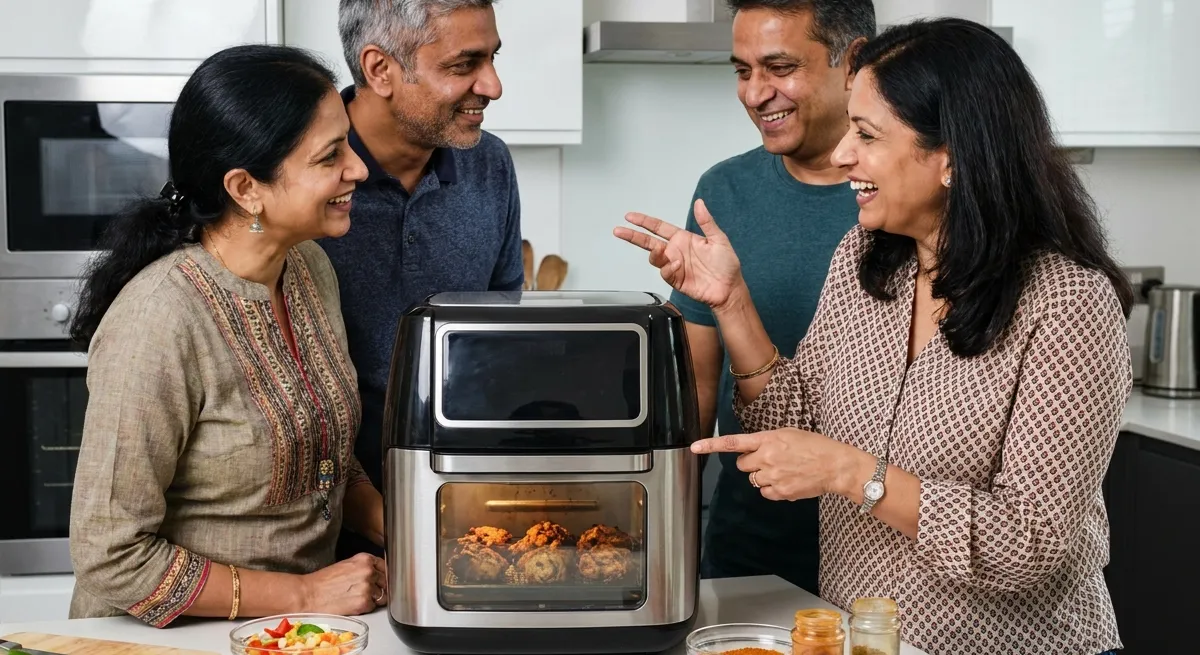
An air fryer does not fry. It is a small convection oven with a strong fan, moving hot dry air fast over the surface of the food. Once you know that, everything about it and Indian cooking falls into place:
- It is a poor deep fryer. A samosa needs to be submerged in oil for its pastry layers to separate. No moving air does that.
- It is a genuinely good small tandoor. A tandoor is dry radiant heat, not oil. Tandoori chicken, paneer tikka, seekh kebabs and papad are what this machine is for.
So the honest answer to am I ruining the samosa is: a frozen one, no — it comes out around ninety per cent of deep-fried. One you rolled yourself, partly — about seventy-five per cent, and the missing quarter is the flakiness.
But you were probably asking the wrong question. Stop asking it to replace your karahi and start asking it to replace a tandoor you never had.
The air fryer arrived in a lot of kitchens as a guilt appliance — the machine that lets you have the fried thing without the frying. Aimed at Indian food, that framing sets it up to fail, because the fried snacks it is being asked to imitate are the one category it is worst at.
Turn it around and the same machine looks completely different.
What it actually is
Strip the marketing away and an air fryer is a compact convection oven: a heating element, a fan that moves air far faster than a normal oven’s, and a small chamber so that air passes over the food many times a minute.
Fast-moving dry air pulls moisture off the surface of food and browns it. That is the whole trick. It is not frying — frying is immersion in hot fat, and fat conducts heat into food perhaps twenty times better than air does, which is why a chip in oil behaves nothing like a chip in an oven.
Most domestic air fryers top out around 400°F (about 200°C). A working tandoor runs at roughly twice that. So it is not a tandoor either. It sits in between, and the useful question is which Indian dishes live in that middle.
What it is genuinely good at: tandoori
A tandoor cooks with fierce dry heat from clay walls and coals. Nothing is submerged, nothing simmers. The marinade dries and chars on the outside while the inside cooks fast enough to stay juicy.
That is a description of dry-heat cooking, and an air fryer is a dry-heat machine. This is the match.
Tandoori chicken
Marinate in two stages. This is not a flourish, it is the technique. First rub the chicken with lemon juice, salt and Kashmiri red chilli and leave it twenty minutes — the acid and salt open the surface. Then the yoghurt stage: thick yoghurt, ginger-garlic paste, cumin, coriander, turmeric, garam masala, a little oil. Several hours, overnight if you can.
Score the meat if it is on the bone. Cuts down to the bone let the marinade and the heat reach the middle, which is the difference between charred outside and cooked through.
Shake the excess off before it goes in. Sitting marinade steams rather than chars, and drips onto the element.
Preheat three to five minutes, then cook at around 390°F for 15 to 20 minutes for boneless pieces, turning once. Bone-in thighs and drumsticks need longer — closer to 25 minutes — and are worth checking at the bone.
Single layer, with air around every piece. This is the rule that matters most and the one people break. Crowd the basket and you have built a steamer. Two batches beat one crowded one every single time.
Paneer tikka
Different problem entirely. Paneer is already cooked and holds very little fat, so you are not cooking it through — you are charring the coating before the inside dries out.
High and short: about 400°F for six to eight minutes, turning once.
The marinade has to be thick. Use hung yoghurt or Greek-style, drained until it clings to a spoon. A thin marinade slides off in the heat and leaves bare paneer, which goes rubbery. Brush the pieces with a little oil or ghee as well.
Take it out while the centre still gives. The single most common mistake is leaving it another five minutes for more colour. Five more minutes is squeaky paneer.
Skewers work well if they fit your basket and let you turn everything at once, but they are convenience, not necessity — pieces in a single layer cook the same.
Papad
The easiest win in this whole article. No oil, around 350–375°F, one to two minutes. Watch it — papad goes from pale to burnt in seconds. It will not blister as dramatically as one held over a gas flame, but it is even, crisp and completely hands-off.
The samosa question, answered straight
You want a number, so here it is.
| How close to deep-fried | |
|---|---|
| Frozen, shop-bought samosa | About 90% |
| Fresh samosa you made yourself | About 75% |
Why frozen does better is counterintuitive and worth knowing: factory samosa pastry is machine-rolled very thin with oil already worked through it. That structure survives dry heat. Pastry you rolled at home is thicker and drier, and it was designed on the assumption that hot oil would get into every layer and push them apart. Moving air cannot do that. The layers stay stuck together and you get a firm shell rather than a shattering one.
How to do it properly:
- Straight from the freezer, do not thaw. A thawed samosa goes soggy and loses its shape.
- Do not brush frozen samosas with oil. They already have plenty in the pastry, and extra makes them greasy rather than crisper.
- About 350°F for 12 to 15 minutes, 10 to 12 for cocktail-sized ones, turning once.
- Single layer, space between them.
And it is worth saying what you gain, not only what you lose: an air-fried samosa is markedly crisper than an oven-baked one, far less greasy than a deep-fried one, and it does not leave you with a pan of used oil. For a weeknight, that is a good trade. For Diwali, fry them.
Putting the smoke back
Here is the gap the machine cannot close on its own. A tandoor gives food two things: extreme heat, and smoke from fat dripping onto coals. An air fryer gives you a fraction of the first and none of the second.
Indian kitchens solved this long before air fryers existed, because most Indian homes have never had a tandoor either. It is called dhungar, and it takes two minutes.
- Hold a piece of natural lump charcoal directly over a gas flame until it glows red and greys over at the edges.
- Put your cooked food in a pan or bowl with a tight lid. Sit a small steel bowl in the middle of it and drop the hot coal in.
- Drip a little ghee onto the coal. It will smoke immediately.
- Cover, tightly, at once. Two to four minutes for paneer, vegetables or raita. Five to eight for chicken, mutton or dal.
- Lift the lid, remove the bowl, serve.
Four things to get right:
- Natural lump charcoal only. Never quick-light briquettes — they contain accelerants, and you are putting that smoke into your food.
- Ventilate the kitchen. You are burning charcoal indoors, briefly, on purpose.
- Never put charcoal inside the air fryer. The dhungar happens afterwards, in a separate covered pan.
- Go easy on the ghee. Too much makes thick acrid smoke and the dish tastes of ashtray rather than tandoor.
Done properly this is the step that makes people ask where you got the food from. It costs almost nothing and it is the single biggest upgrade on this page.
What it cannot do
Curry. No gravy has ever been made in a basket of moving air. There is no way to bhuna an onion-tomato base, and liquid either spatters onto the element or sits there refusing to reduce. Gravies belong in a pan, or in an electric pressure cooker.
Volume. Everything here depends on a single layer with air moving around each piece. That caps how much you can cook at once, and it does not scale for guests.
A real tandoor char. Half the temperature means half the char. Dhungar closes some of the gap. It does not close all of it, and anyone claiming otherwise has not eaten much tandoori food.
Anything with a wet batter. Pakora batter drips through the basket and bakes onto the element. Bhajis and pakoras need oil, and there is no honest workaround.
The most useful way to think about it: the air fryer handles the dry component, the pan handles the wet one. Air-fry the paneer, then fold it into a gravy you made properly. That is not a compromise — it is close to how a restaurant kitchen splits the same job.
If you are buying one
This is a $100-ish appliance, so the decision is smaller than it was for a pressure cooker. Three things matter for this food:
- A basket big enough for a real single layer. Around 6 quarts suits a family. Everything on this page is limited by floor area, not by the machine’s cleverness, and a small basket means cooking in batches forever.
- A temperature ceiling of 400°F. Most reach it. Tandoori wants the top of the range, not the middle.
- A basket and crisper plate you can actually clean. Yoghurt marinade bakes on hard. Dishwasher-safe parts are worth more here than any preset.
Ignore preset counts. A tandoori preset is a temperature and a timer with a picture on it, and the timings above are better than any of them.
A dual-basket model is worth considering if you cook this way often, because tandoori chicken and paneer want different times, and doing them in one basket means one of them waits.
Where the flavour is
Everything on this page is a heat source. None of it seasons anything.
Tandoori food tastes the way it does because of the marinade — the acid stage, the thick yoghurt, and the spices in it. That is where a home cook’s version usually falls short, and it is nothing to do with the appliance: too little Kashmiri chilli for colour, garam masala added too early so it bakes flat, no cardamom or clove warmth behind the cumin, too little salt for the amount of yoghurt.
Knowing what each of those is contributing is what lets you fix a marinade instead of following one. That is what the spice guides are for, one spice at a time, and what the Spice Pharmacopeia volumes go further into.
Buy the machine for the tandoori. The samosas are a bonus, and now you know exactly how much of one.
Common questions
Can you make tandoori chicken in an air fryer?+
Yes, and it is the single best thing an air fryer does with Indian food. Tandoori is not fried — it is cooked by dry radiant heat in a clay oven, and an air fryer is a small convection oven with a strong fan, which is far closer to that than any frying pan. Marinate, shake off the excess, arrange in a single layer with space around each piece, and cook at around 390°F for 15 to 20 minutes for boneless pieces, turning once. What you will not get is the char and smoke of a real tandoor, which runs at roughly twice the temperature. There is a fix for that further down this page.
Do samosas work in an air fryer?+
Frozen ones work very well — most people put them at around ninety per cent of deep-fried, and they are far crisper than oven-baked and much less greasy. Samosas you have made yourself get to roughly seventy-five per cent, and the gap is real: shortcrust-style samosa pastry needs to be submerged in oil for its layers to separate and blister. Cook frozen samosas straight from the freezer at about 350°F for 12 to 15 minutes, and do not brush them with oil — the factory pastry already has oil worked into it, and adding more makes them greasy.
What temperature should I use for paneer tikka in an air fryer?+
High and short: around 400°F for six to eight minutes, turning once. Paneer is already cooked, so you are not cooking it through — you are charring the marinade on the outside before the inside has time to dry out and turn rubbery. That is why the temperature is high and the time is short, and why leaving it in for another five minutes to get more colour is the mistake almost everyone makes once.
Why is my air fryer paneer dry and rubbery?+
It has been in too long, the marinade was too thin, or both. Paneer holds very little fat and nothing protects it in dry heat except the coating on the outside, so a watery marinade runs off and leaves the surface bare. Use thick, hung or Greek-style yoghurt, drained until it clings to a spoon, and take the paneer out while the edges are charred but the centre still gives when pressed. Brushing the pieces with a little oil or ghee before cooking helps as well.
Can you cook papad in an air fryer?+
Yes, and it is one of the easiest wins. No oil at all, around 350 to 375°F, and it takes roughly one to two minutes — watch it, because papad goes from pale to burnt in seconds. It will not puff and blister as dramatically as one held over a flame, but it is crisp, evenly cooked and completely hands-off, and you can do several at once if they sit in a single layer.
Do I need to preheat an air fryer for Indian food?+
For anything you want charred rather than merely cooked, yes. Tandoori chicken, paneer tikka and kebabs all rely on the surface searing before the inside dries out, and a cold basket wastes the first several minutes warming up instead. Three to five minutes is enough. For reheating samosas or cooking papad it makes very little difference.
Can you make curry in an air fryer?+
No, and it is worth being blunt about it. An air fryer moves hot dry air over food; a curry is a wet dish that needs a base cooked in fat, then simmering. There is no way to build an onion-tomato masala in a basket, and liquid in an air fryer will either spatter across the element or sit there without reducing. You can air-fry the paneer, chicken or vegetables and then add them to a gravy you made in a pan — that is a real and useful way to use both machines.
How do I get the smoky tandoori flavour at home?+
Use the dhungar method, which is what Indian kitchens have always done without a tandoor. Heat a piece of natural lump charcoal directly over a flame until it glows red and greys over, sit it in a small steel bowl in the middle of your finished dish, drip a little ghee onto it, and immediately cover the pan with a tight lid. Two to four minutes for paneer or vegetables, five to eight for chicken or dal. Use natural lump charcoal only — never quick-light briquettes, which carry chemical accelerants — keep the kitchen ventilated, and never put charcoal inside the air fryer itself.
New: Google now lets you choose which sites it shows you first. One tap lifts our spice guides in your results — nobody else's — and you can undo it any time.