
Turmeric
Turmeric vs Curcumin: Why Your Golden Latte and Your Supplement Aren't the Same Thing
Quick answer
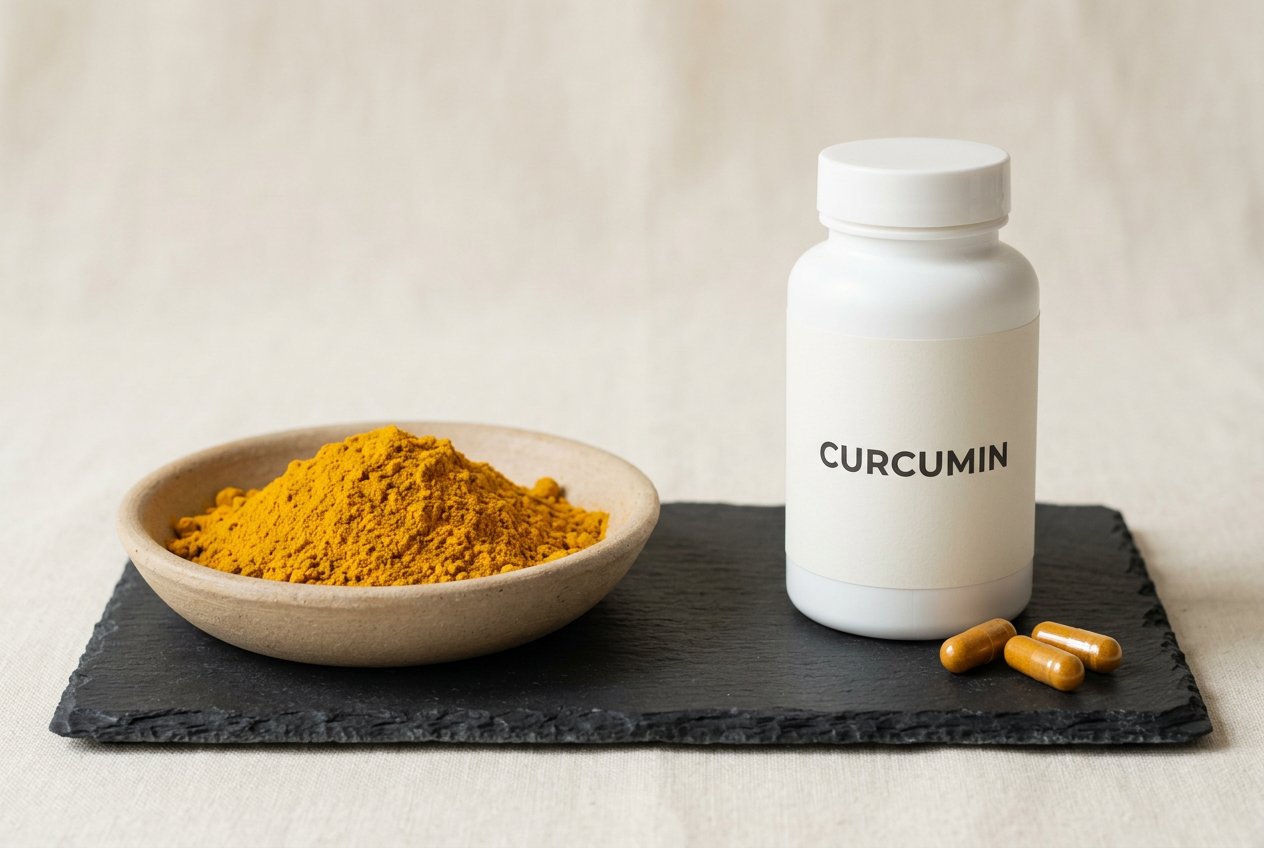
Turmeric is the whole golden spice — the ground root of Curcuma longa. Curcuminoids are the active compounds inside it, and curcumin is the most studied one, making up only about 2–5% of turmeric by weight. So your golden latte is a food-level dose of the whole spice, while a curcumin capsule is a concentrated extract many times stronger that behaves more like a drug. That single distinction explains almost everything: why supplements are studied but lattes mostly aren’t, and why turmeric-in-food is very safe while high-dose supplements carry real cautions. Cooking? Use turmeric. Targeting a specific health goal? That’s a curcumin (supplement) question.
Here’s a confusion that costs people money and, occasionally, their health: they see “turmeric” and “curcumin” used as if they’re the same word. A wellness video shows someone making a golden latte and then cites a study on curcumin’s anti-inflammatory power — as if the mug and the study are talking about the same thing. They aren’t. Untangling this one distinction is the most useful five minutes you’ll spend on turmeric.
One root, three words
Think of it as a set of nested containers:
- Turmeric — the whole spice. The dried, ground root that colours curry and golden milk.
- Curcuminoids — the small family of active yellow compounds inside turmeric. They make up only about 2–5% of the powder.
- Curcumin — the star curcuminoid, the one nearly all the research focuses on.
So when a headline says “curcumin reduces joint pain,” it almost never means the spice in your kitchen. It means a standardised extract concentrated to around 95% curcuminoids — a form you’d never get from a spoonful of turmeric.
The mental model: turmeric is the orange; curcumin is a concentrated shot of the juice. Same origin, very different dose.
Why this difference changes everything
This isn’t pedantry — the gap between the two is enormous and practical.
A teaspoon of turmeric (about 3 grams) contains only roughly 100–150 mg of curcuminoids, and your body absorbs just a sliver of that. A typical curcumin supplement delivers 500–1,000 mg of curcuminoids per serving, often in high-absorption forms designed to get far more into your blood. That’s not a small difference of degree — it’s the difference between a food and a concentrated product with drug-like behaviour.
It’s also why two statements that sound contradictory are both true:
- “Turmeric is completely safe — people have eaten it for centuries.” ✅ (the food)
- “Turmeric supplements have been linked to rare liver injury.” ✅ (the concentrated extract)
They’re simply describing different things. Keep them separate and turmeric stops being confusing.
Which one do you actually need?
Reach for turmeric (the spice) if you want to:
- cook — curries, dals, rice, roasted vegetables, eggs;
- make golden milk or turmeric tea as a daily ritual;
- add colour, warmth, and a reason to eat more plants.
This is safe, cheap, and genuinely worthwhile — no supplement required.
Consider curcumin (a supplement) — ideally with your clinician — if you want to:
- target a specific, studied goal like knee osteoarthritis pain, where trials used concentrated doses;
- reach research-level amounts you simply can’t get from food.
And if you go the supplement route, absorption is everything — plain curcumin barely absorbs, so the form matters more than the milligrams. We break that down here: Turmeric shots & supplements — are you actually absorbing any of it? →.
Starting from scratch? A good organic turmeric covers all the cooking, and a standardised curcumin extract is the concentrated form for supplementing. → HQOExpress organic ground turmeric · standardised curcuminoid extract. As an Amazon Associate we may earn from qualifying purchases.
How to read a label without getting fooled
Supplement labels lean on the confusion. Protect yourself:
- “Turmeric 1,000 mg” tells you the weight of powder, not the active dose. Look for a curcuminoid figure — “standardised to 95% curcuminoids.”
- No stated absorption system (phytosome, lipid, or piperine)? Most of it won’t reach your bloodstream.
- “Proprietary blend” hiding the amounts? You can’t know your real dose — skip it.
The bottom line
Turmeric and curcumin aren’t rivals — they’re the spice and its concentrated active compound. Your golden latte is turmeric: a lovely food-level ritual. A curcumin capsule is the extract: a concentrated, drug-like product with real benefits and real cautions. Once you stop treating them as the same word, every other turmeric question — does it work, is it safe, what should I buy — gets a lot clearer.
Want the whole picture, from absorption to safe dosing to what turmeric genuinely helps? It’s in our ebook, Turmeric: Nature’s Anti-Inflammatory, starting with Chapter 1.
Related reading:
Frequently asked questions
Is curcumin the same as turmeric?+
No. Turmeric is the whole spice; curcumin is one active compound inside it, the main curcuminoid, making up only about 2 to 5% of turmeric by weight. Most health research is done on concentrated curcumin extracts, not the spice.
Should I take turmeric or curcumin?+
For cooking and daily rituals like golden milk, use turmeric; it's safe and cheap. For a specific, studied health goal, a concentrated curcumin supplement discussed with your clinician is what the research actually used.
How much curcumin is in turmeric powder?+
Only about 2 to 5% by weight, roughly 100 to 150 mg of curcuminoids per teaspoon of powder, and your body absorbs just a fraction of that. Supplements deliver far more, which is why they're studied and the spice generally isn't.
Is curcumin stronger than turmeric?+
Yes, by a wide margin. A curcumin supplement is a concentrated extract delivering many times the curcuminoids of a food amount of turmeric, often in high-absorption forms, which is why it can behave more like a drug with more benefit potential and more caution needed.
Can I just eat more turmeric instead of taking curcumin?+
You can enjoy turmeric freely in food, but you can't realistically eat your way to research-level curcumin doses because the amounts and absorption are too low. If that's your goal, a supplement is the tool; for everyday benefits of a healthy spice, food is perfect.
New: Google now lets you choose which sites it shows you first. One tap lifts our spice guides in your results — nobody else's — and you can undo it any time.
More on Turmeric
Turmeric Benefits for Men: What Holds Up, and What Is Being Sold to You
Turmeric is marketed to men for testosterone, muscle recovery and prostate health. Here is what the human evidence actually supports, what it does not, and how to tell a useful turmeric supplement from an inert one.
Turmeric Side Effects: The Ones That Are Real, and Who They Apply To
Most turmeric side-effect lists blur the spice and the supplement together. Here is the honest split — what culinary turmeric can do, what concentrated curcumin can do, which medications interact, and the warning signs worth acting on.
Is Turmeric Bad for Your Liver? What the Recent Warnings Actually Mean
Doctors have linked some trendy turmeric supplements to rare liver injury — and the black-pepper combo everyone recommends may be part of the problem. Here's the honest, evidence-based picture: who's at risk, the warning signs, and how to use turmeric safely.