
Cayenne
Kashmiri Chilli Powder Substitute — and What It Actually Is
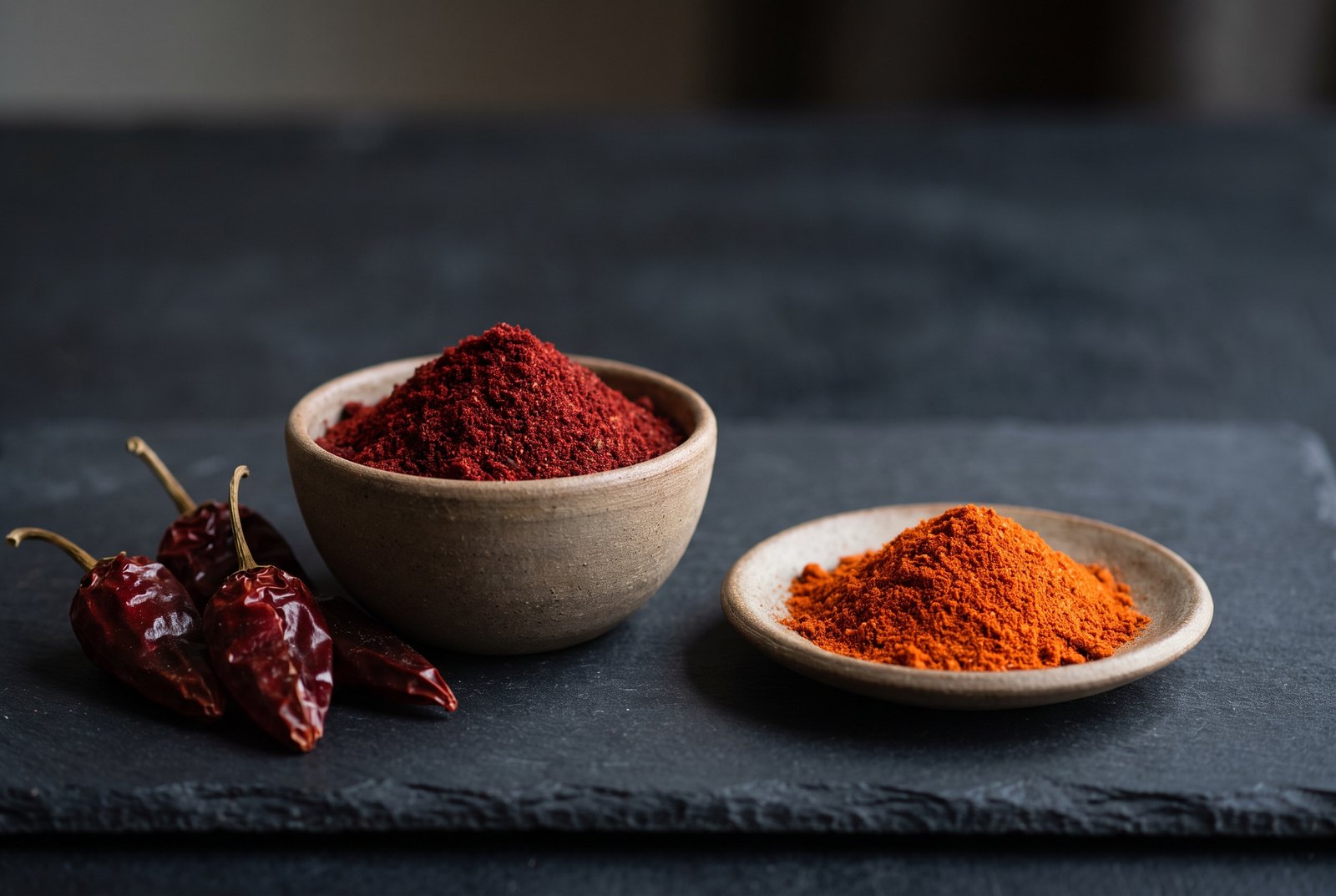
Quick answer
Sweet paprika, one for one, plus a pinch of cayenne.
For 1 tsp Kashmiri chilli powder: use 1 tsp sweet paprika + 1/8 tsp cayenne.
Paprika brings the deep red colour and the mild fruitiness. The cayenne puts back the small amount of heat paprika lacks. If you have deggi mirch, use that instead at 1:1 and taste — it is a shade hotter.
What you must not do is reach for ordinary chilli powder at the same amount. Kashmiri is measured in spoonfuls, and ordinary chilli powder at spoonful quantities is inedible.
Most chilli is bought for what it does to your mouth. Kashmiri chilli is bought for what it does to the pot.
What Kashmiri chilli actually is
A mild, wrinkled, deep-red Indian chilli, at roughly 1,000 to 2,000 Scoville units — about the same as a mild jalapeño, and around a twentieth of cayenne.
Its value is colour. Kashmiri chilli is unusually rich in the red carotenoid pigments and unusually poor in capsaicin, so it delivers a saturated red at quantities that would be unthinkable with any other chilli. That is why an Indian recipe can call for two tablespoons of chilli powder and still produce something the whole family eats.
This is the reason the substitute has to be chosen carefully. Swap in something hotter and you have not made the dish spicier — you have made a different dish, one that is now too hot to eat and still not red enough.
The swaps
Amounts replace 1 teaspoon of Kashmiri chilli powder.
| Substitute | Amount | Notes |
|---|---|---|
| Sweet paprika + cayenne | 1 tsp + 1/8 tsp | The best answer. Colour, sweetness and a little heat |
| Deggi mirch | 1 tsp | Closest shop product. A blend, slightly hotter |
| Sweet paprika alone | 1 tsp | Colour without the edge. Perfectly usable |
| Byadgi chilli powder | 1 tsp | Effectively the same thing under its real name |
| Ancho powder | 1 tsp | Mild and dark, but raisin-sweet and Mexican in flavour |
| Ordinary chilli powder + paprika | 1/4 tsp + 3/4 tsp | Rebuilds heat and colour separately |
| Smoked paprika | 1 tsp | Right colour, wrong flavour. Smoke belongs elsewhere |
Do not use hot paprika here. Sweet is what you want: the whole point is colour without heat, and the hot version only muddies the calculation.
Deggi mirch, and why it is not quite the same
Deggi mirch is sold beside Kashmiri chilli in every Indian grocery and is often described as identical. It is not.
It is normally a blend — a Kashmiri-type chilli mixed with a hotter variety, sometimes with dried red capsicum for extra colour. So it is a little hotter, and the amount of “a little” changes with the brand. Swap it 1:1, but taste at half quantity before you commit to the rest, especially in something delicate.
By dish
Tandoori marinades
The most colour-dependent thing in the whole repertoire, and the one worth getting right. Paprika and cayenne together do this well. If you use paprika alone the marinade comes out slightly pale and slightly flat; the pinch of cayenne fixes both.
Rogan josh
Traditionally coloured with Kashmiri chilli in real quantity — this is the dish the spice is famous for. Paprika at 1:1 carries it, and a whole dried mild chilli dropped into the pot alongside adds back some of the depth that ground powder loses.
Butter chicken and other tomato-cream curries
Forgiving. The tomato is already doing colour work and the cream lifts everything a shade lighter, so plain sweet paprika is fine on its own.
Dal tadka and everyday cooking
Kashmiri chilli in a tadka is there to tint the hot oil red before it hits the dal. Paprika behaves the same way, but it is more delicate — it burns and turns brown in seconds. Add it off the heat, after the seeds have popped, and swirl it in.
Buying it, if you decide to
Three things to look at, in order.
Colour. This is the entire product. A brick-red or brownish powder has been sitting in the light and its pigments have already gone; you are buying dust. Deep, almost glowing red is what you are paying for, and it is the first thing to fade.
The name on the label. Kashmiri on a jar generally describes a style — high colour, low heat — and not a place of origin. Most of it is Byadgi, grown in Karnataka, and Byadgi does the job honestly. Be sceptical of a jar priced like a rarity, and completely relaxed about one that says Byadgi outright.
Whole or ground. Whole dried Kashmiri chillies keep their colour far longer than powder, and grinding them takes seconds in a spice mill. If you cook Indian food weekly, buy whole. If it is occasional, buy the smallest jar of powder you can find and finish it inside six months.
If you would rather buy the real thing than approximate it: organic Kashmiri mirch is a single-ingredient ground Kashmiri chilli in a 200 g pack. Judge it the way this section says to — on how deep the red is when you open it, not on the word on the front. As an Amazon Associate we may earn from qualifying purchases.
The bottom line
Kashmiri chilli is a colour spice that happens to be a chilli, so replace it with another colour spice: sweet paprika at 1:1, with a pinch of cayenne for the heat it is missing. Deggi mirch is the nearest shop-bought stand-in and is slightly hotter. Never substitute an ordinary chilli powder measure for measure. And when you buy the real thing, buy it for how red it is, not for the word on the front.
Related reading:
Frequently asked questions
What is a substitute for Kashmiri chilli powder?+
Sweet paprika, measure for measure, plus a pinch of cayenne. For 1 teaspoon of Kashmiri chilli powder use 1 teaspoon of sweet paprika and about 1/8 teaspoon of cayenne. Paprika supplies the colour and the mild sweetness, and the cayenne puts back the small amount of heat that paprika does not have.
Is Kashmiri chilli powder hot?+
Barely. It sits at roughly 1,000 to 2,000 Scoville units, which is around a twentieth of cayenne and about the same as a mild jalapeño. It is grown and sold for its deep red colour, not for heat, which is why a dish can carry two full tablespoons of it without becoming fiery.
Can I use regular chilli powder instead of Kashmiri?+
Not at the same amount. Ordinary Indian red chilli powder can be twenty times hotter, so a tablespoon of it in place of a tablespoon of Kashmiri makes the dish inedible while still not looking as red. Use a quarter teaspoon of it plus paprika to make up the colour and the volume.
Is deggi mirch the same as Kashmiri chilli?+
Not quite. Deggi mirch is usually a blend — Kashmiri-type chilli mixed with a hotter variety, or with capsicum for colour — so it is a little hotter than pure Kashmiri and varies by brand. It is the closest thing on an Indian grocery shelf and swaps in at roughly 1:1, but taste before you commit the whole amount.
What does Kashmiri chilli powder do in a recipe?+
Colour, mostly. It is what makes tandoori chicken red, rogan josh dark and glossy and butter chicken orange, without the heat those colours would imply if they came from an ordinary chilli. It also carries a mild fruity sweetness that ordinary chilli powder does not.
Is Kashmiri chilli powder actually from Kashmir?+
Usually not. True Kashmiri chilli is grown in small quantities and rarely leaves India. Most powder sold under the name is Byadgi chilli from Karnataka or a similar high-colour, low-heat variety, sold as Kashmiri because the word now describes a style. That is not a scandal — Byadgi does the same job well — but it is worth knowing when a jar is priced as though it were rare.
New: Google now lets you choose which sites it shows you first. One tap lifts our spice guides in your results — nobody else's — and you can undo it any time.
More on Cayenne
Cayenne Pepper Substitute: What to Use, and How Much
The best cayenne pepper substitutes with exact swap amounts — red pepper flakes, hot paprika, chili powder, gochugaru and hot sauce — by dish, plus the two swaps that quietly ruin a recipe.
Cayenne vs Chili Powder vs Paprika: Which Red Powder Do You Need?
Three red powders, one constant mix-up. What cayenne, chili powder, paprika and Indian red chilli powder each are, how much hotter one is than the next, and which two jars are worth owning.
Chili Flakes vs Red Pepper Flakes: Are They the Same Thing?
In an American kitchen they are the same jar. In a British one they are often not. What the two labels mean, why gochugaru and Aleppo are also sold as chilli flakes, and when swapping them actually matters.