
Star Anise
Star Anise vs Anise: Two Different Plants, and One That Is Not Food
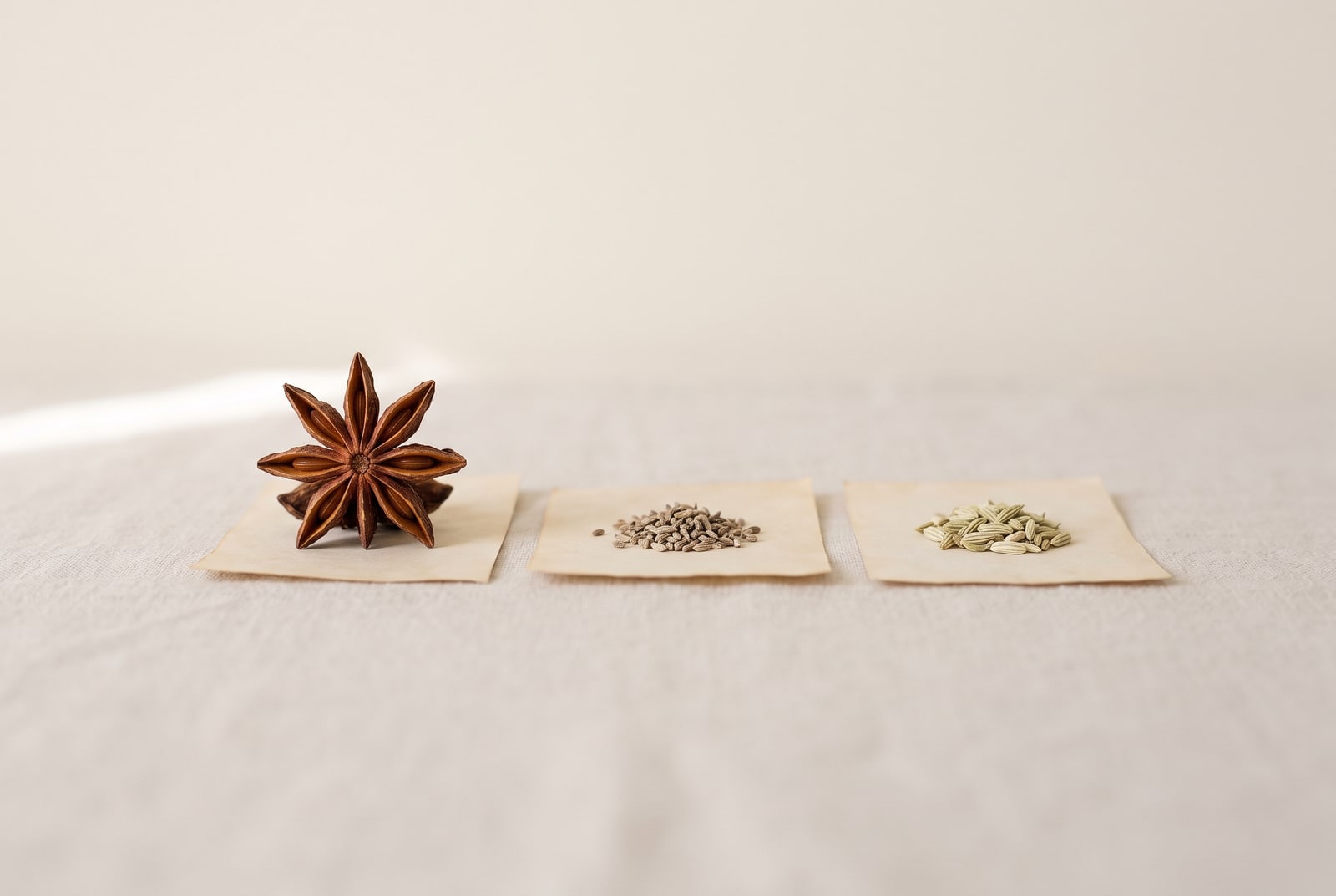
Quick answer
They are not the same plant and they are not related.
Star anise is the dried fruit of Illicium verum, an evergreen tree from southern China and Vietnam. Aniseed is the seed of Pimpinella anisum, a small Mediterranean herb in the carrot family. Fennel, which is often thrown into the same confusion, is a third plant again.
All three taste of licorice because all three contain anethole. That is the whole of the relationship.
Star anise is the strongest and belongs in long savoury cooking. Aniseed is sweeter and belongs in baking. Fennel is the mildest.
And there is a fourth thing on this list that is not food. Illicium anisatum, Japanese star anise, looks close enough to the culinary species to pass and is toxic. That section is at the bottom, and it is the reason this page exists in the form it does.
There is a rule of thumb in botany that similar names mean similar plants. Star anise is the exception that comes up most often in a kitchen.
Two spices, three if you count fennel, four if you count the one you must not eat — all tasting broadly alike, none of them related, and all of them sold within a metre of each other.
The three at a glance
| Star anise | Aniseed | Fennel seed | |
|---|---|---|---|
| Plant | Illicium verum | Pimpinella anisum | Foeniculum vulgare |
| Family | Schisandraceae | Apiaceae (carrot) | Apiaceae (carrot) |
| Part used | Whole dried fruit | Seed | Seed |
| From | S. China, Vietnam | Mediterranean, SW Asia | Mediterranean |
| Looks like | 8-pointed woody star, 2–3 cm | Tiny grey-brown seed | Pale green ridged seed |
| Strength | Strongest | Medium | Mildest |
| Tastes of | Licorice, wood, faint bitterness | Sweet licorice | Soft licorice, grassy |
| Belongs in | Braises, broths, five-spice | Baking, liqueurs, sausage | Curries, fish, salads, tea |
| Survives long cooking | Yes, very well | No | Moderately |
Aniseed and fennel are genuinely related — both are in the carrot family, alongside cumin, coriander, dill and caraway. Star anise is not in that family or anywhere near it. Its closest relatives are ornamental shrubs and a Chinese medicinal vine.
Why unrelated plants taste the same
The answer is anethole, an aromatic compound that all three produce independently.
Anethole is the licorice flavour. It is also the dominant compound in liquorice root itself, which is a fourth unrelated plant — a legume, in the same family as peas and beans. Four families, one taste.
This is convergent evolution in a spice rack: unrelated plants arriving at the same chemistry because it was useful to them, and humans then filing them together on a shelf because our tongues cannot tell the difference in origin.
It has one practical consequence worth knowing: because the shared compound is genuinely the same, these three substitute for each other unusually well. Most spice substitutions are approximations. This one is closer to a straight swap at the right ratio.
What separates them in practice
Strength and the swap ratio
Star anise is the strongest by a wide margin.
One whole star anise pod ≈ 1/2 teaspoon aniseed ≈ 3/4 teaspoon fennel seed.
Those are starting points. The full substitution table, sorted by dish →
How long they last in a pot
This is the difference that actually decides which one a recipe wants.
Star anise is a hard woody pod. It gives up its flavour slowly and keeps giving for hours, which makes it right for a pho broth, a red-braise or a stock. Aniseed is a small soft seed. It releases everything quickly and then fades, which makes it right for baking, where the cooking time is short and the spice is inside the food rather than steeping beside it.
Put aniseed in a four-hour stock and it will be gone before the stock is. Put star anise in a biscuit and it will be woody and bitter unless it was ground very fine.
Where each one traditionally belongs
Star anise — Chinese and Vietnamese savoury cooking above all. Pho, red-braised pork, char siu, soy-braised eggs, five-spice powder. In India it appears as a whole spice in biryani, pulao and some garam masala blends.
Aniseed — European and Middle Eastern baking and drinking. Biscotti, springerle, pfeffernüsse, anise bread. Ouzo, sambuca, pastis, raki and arak are all anethole drinks. In the Levant, anise tea after a meal.
Fennel — the broadest range of the three, because the plant is also a vegetable. The seed goes into Italian sausage, Indian panch phoron, fish dishes and after-dinner mukhwas; the bulb is roasted or shaved raw.
The confusion that matters: two species of star anise
Everything above is a cooking question. This part is a safety question, and it is the reason to be careful about where star anise is bought.
What Japanese star anise is
Illicium anisatum — shikimi in Japanese — is a small evergreen shrub grown as an ornamental. In Japan its branches are placed at graves and burned as incense near Buddhist temples. It has never been a food.
Its fruit contains anisatin and related neurotoxic sesquiterpene compounds. All parts of the plant are toxic. It is not a weaker or riskier version of the culinary spice; it is a different species that happens to make a similar-looking fruit.
Why a cook ever encounters it
Because it is cheaper, and because it looks close enough to pass in a sack of dried pods. Adulteration of culinary star anise with the Japanese species has been documented, and it is the specific reason regulators in several countries have issued warnings about star anise teas.
The reported cases of illness have overwhelmingly involved infants given star anise infusions for colic — a practice traditional in several countries. That combination is the worst case: a very small body, an unmeasured amount steeped at home, and a possible adulterant.
Do not give star anise tea to a baby. That is the one piece of advice on this page that is not about flavour.
How to actually tell them apart
The published visual differences are real:
| Chinese (I. verum) | Japanese (I. anisatum) | |
|---|---|---|
| Points | Usually 8 | Often 10–13 |
| Follicles | Plump, evenly formed | Smaller, more shrivelled |
| Smell | Strong, sweet licorice | Weaker, medicinal, faintly clove-like |
| Taste | — | Do not taste it |
But do not rely on them. Point counts overlap. A sack of dried pods contains broken pieces. Smell is subjective and both are aromatic. And none of it survives grinding — ground star anise cannot be inspected at all.
The reliable method is the label. Buy whole pods from a seller who states Illicium verum, or names the origin and the species clearly. Avoid ground star anise from a source that names neither.
In practice that usually means choosing the company rather than the product page, because retail listings very often do not print botanical names. Frontier Co-op’s organic whole star anise is the one we use: the Amazon page does not carry the Latin name, but Frontier’s own catalogue lists this exact product as Illicium verum, grown in Vietnam, certified organic and non-irradiated. Species named, origin named, by the people who packed it. That is the standard to hold a supplier to.
This is the same argument as buying Ceylon cinnamon by name rather than trying to identify bark by eye, and the same argument as the label test on chilli blends. When a visual check is unreliable, the packaging is the test. The difference here is the stakes: cassia is a coumarin question about long-term intake, and this is a different species that is not food at all.
A note for the nervous
Culinary star anise is safe. It is in an enormous proportion of Chinese and Vietnamese cooking, eaten daily by hundreds of millions of people, and the pod in a pho broth is not a risk to an adult.
The point of the section above is not that star anise is dangerous. It is that the supply chain has a known adulterant and a label solves it. Buy the named product, keep it whole, and cook with it happily.
Related guides
Frequently asked questions
Is star anise the same as anise?+
No. They are unrelated plants from different botanical families that happen to share one flavour compound. Star anise is the dried fruit of Illicium verum, an evergreen tree native to southern China and Vietnam. Anise, or aniseed, is the seed of Pimpinella anisum, a small herb in the carrot family from the Mediterranean. Both contain anethole, which is why both taste of licorice. That is the entire relationship — they are not varieties of each other and neither is a stronger version of the other.
What is the difference in taste between star anise and aniseed?+
Star anise is bolder, woodier and slightly bitter, with a medicinal depth that comes from the tough pod rather than the seeds inside it. Aniseed is sweeter, lighter and more delicate. The practical consequence is that star anise holds up to hours of simmering and aniseed does not, which is why star anise belongs in braises and broths and aniseed belongs in baking and liqueurs.
What is the difference between anise, star anise and fennel?+
Three unrelated plants sharing one compound. Anise and fennel are both in the carrot family but are different genera; star anise is not related to either. In strength, star anise is the boldest, aniseed is in the middle, and fennel is the mildest with a grassy note the others lack. Fennel is also the only one of the three eaten as a vegetable, since the bulb, fronds and seed all come from the same plant.
Which is stronger, anise or star anise?+
Star anise, by a clear margin, and the ratio matters when swapping. About half a teaspoon of aniseed replaces one whole star anise pod. Star anise also releases its flavour slowly because the pod is woody, so in a long-cooked dish the gap widens further — aniseed will have faded well before a stock is finished while star anise is still giving.
How do you tell Japanese star anise from Chinese star anise?+
By the label rather than by eye, and this is the honest answer rather than a cautious one. The published visual differences are real — Japanese pods tend to have more points, smaller and more shrivelled follicles, and a weaker, more medicinal smell — but they are unreliable in practice and useless once anything is broken or ground. Buy whole pods from a seller who states Illicium verum on the packaging, and avoid ground star anise from an unnamed source.
Is Japanese star anise poisonous?+
Yes. Illicium anisatum contains neurotoxic sesquiterpene compounds and is not edible. It is grown as an ornamental shrub and burned as incense in Japan, where it is called shikimi, and it has never been a culinary spice. It matters to cooks only because it looks similar to the culinary species and has been found adulterating shipments of it, since it is cheaper. The defence is buying from a source that names the species.
Who should not use star anise?+
Infants, under any circumstances, and anyone who cannot be confident of the species. Culinary star anise is safe for adults in the amounts a recipe uses. The illness reports that exist have overwhelmingly involved star anise teas given to babies for colic, where a small body meets an unclear amount and a possible adulterant. If you are pregnant, breastfeeding or taking medication, ask a pharmacist rather than a website. This site does not publish doses.
Can you eat star anise whole?+
No — it is a flavouring rather than something you chew. The pod is hard and woody and is meant to be simmered in liquid then removed before serving, like a bay leaf or a cinnamon stick. Biting one is unpleasant rather than dangerous. Ground star anise is a different product and is used in small measured amounts inside a blend.
New: Google now lets you choose which sites it shows you first. One tap lifts our spice guides in your results — nobody else's — and you can undo it any time.
More on Star Anise
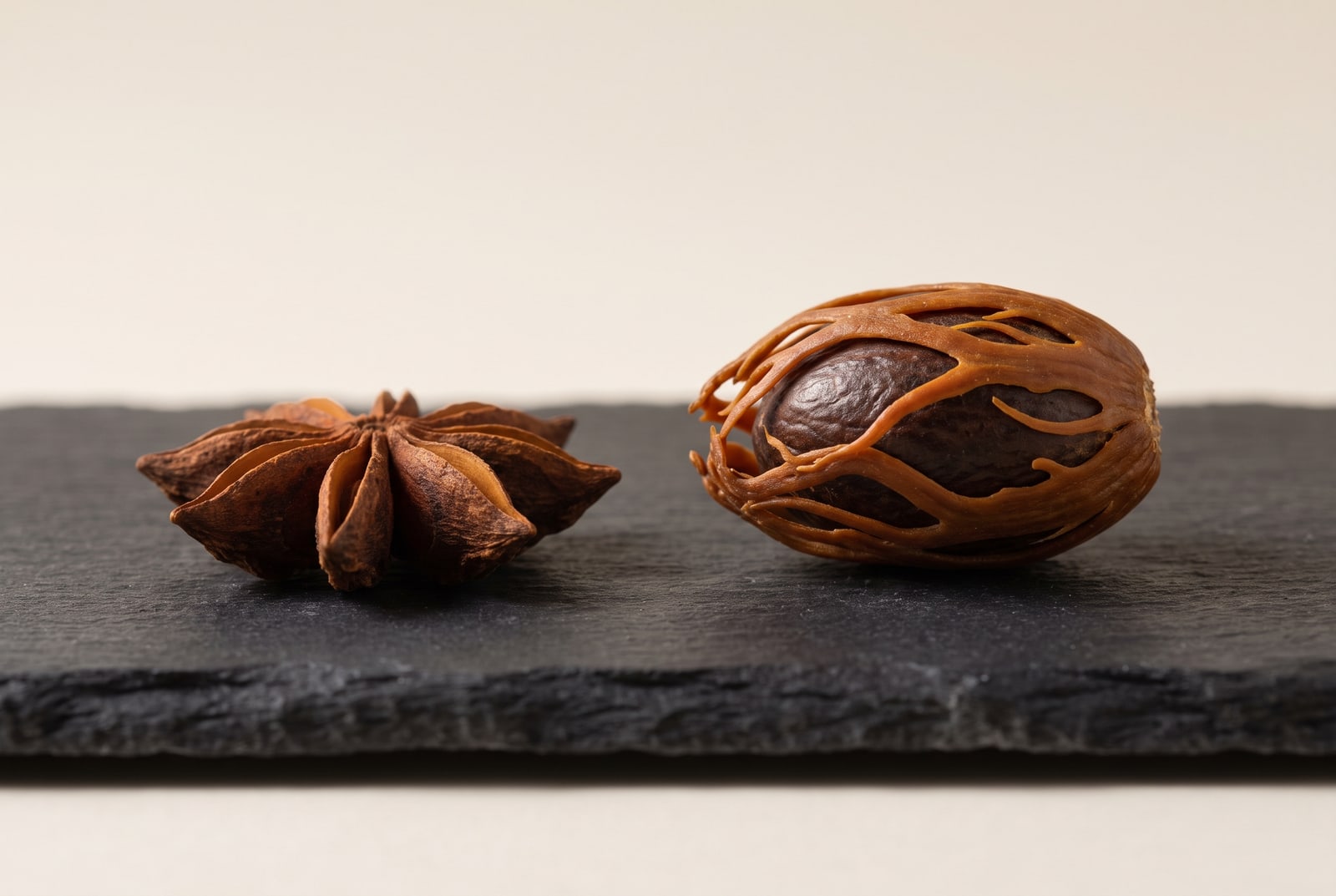
Star Anise in Hindi: Chakra Phool, Badiyan, and the Spice It Gets Confused With
Star anise in Hindi is chakra phool. Also badiyan, anasphal and biryani flower — every Indian name for it, what it does in a biryani, and why it is not javitri.
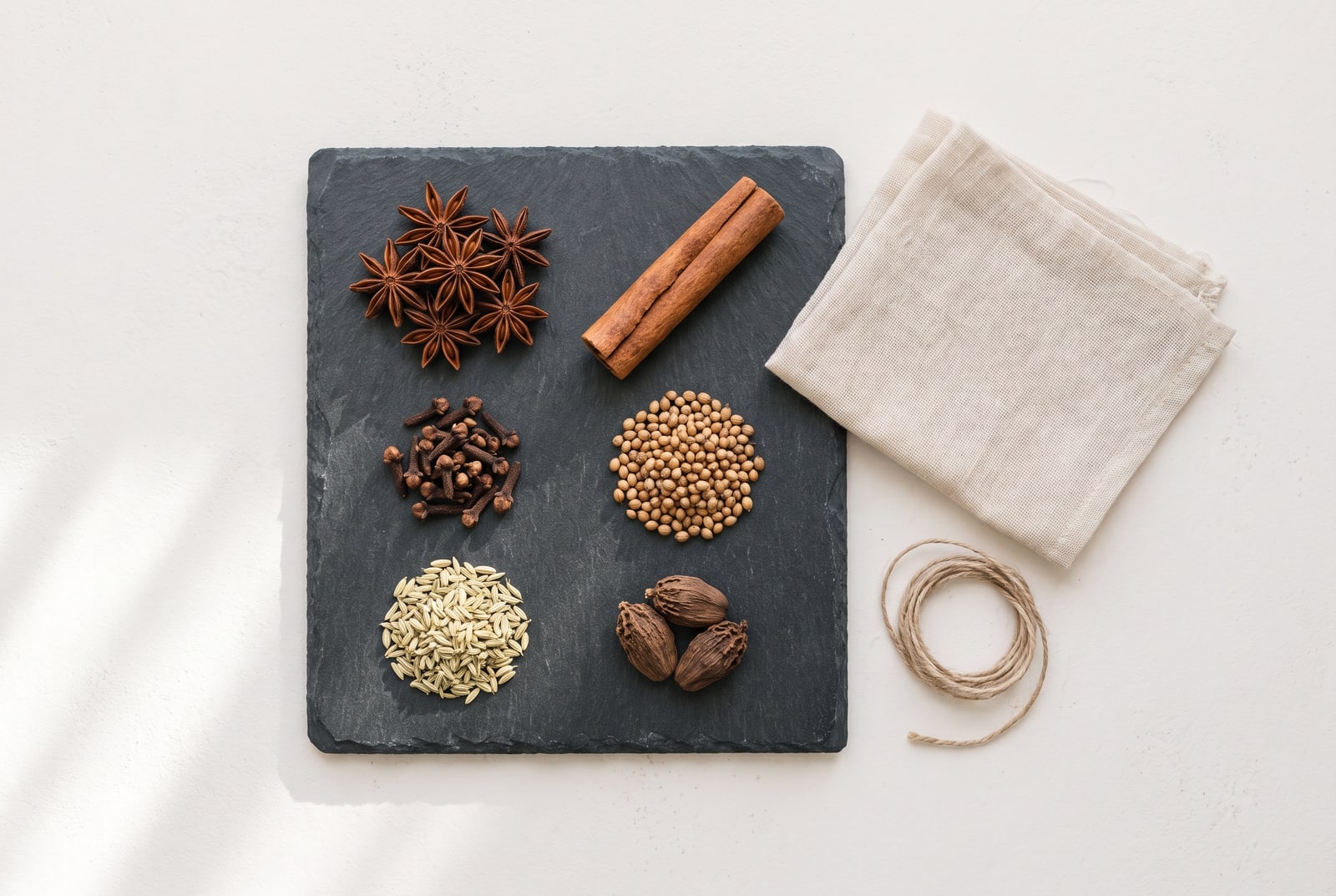
Star Anise in Pho: What It Does, and the Five Spices Beside It
What star anise actually contributes to a pho broth, how much to use, why it must be toasted first, and what each of the other five spices in the bundle is doing — a spice guide, not a broth recipe.
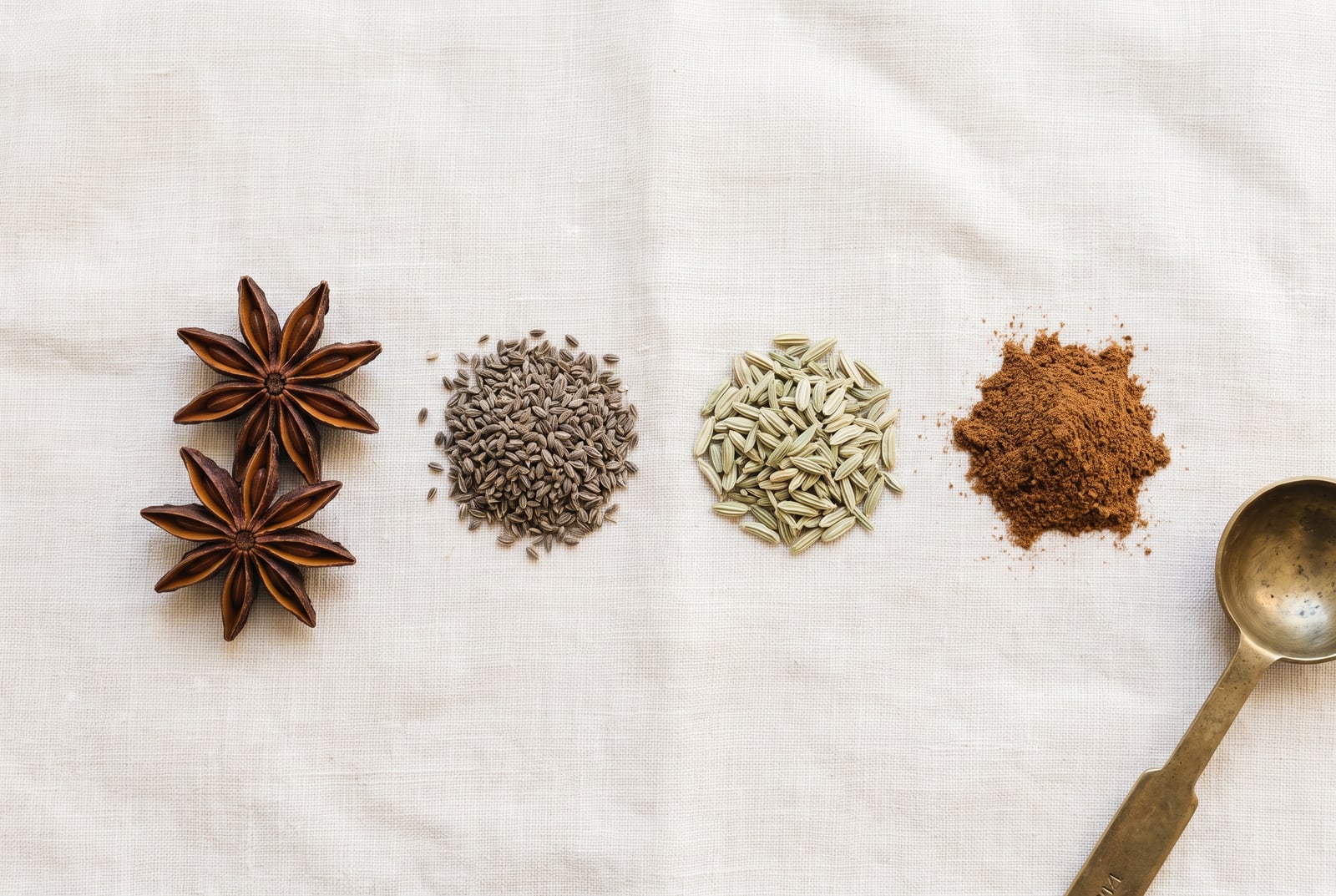
Star Anise Substitute: What to Use, by Dish
The best star anise substitutes with exact swap amounts — five-spice, aniseed, fennel, cloves and cinnamon — sorted by what you are cooking, plus the two dishes where leaving it out beats substituting.