
Star Anise
Star Anise in Hindi: Chakra Phool, Badiyan, and the Spice It Gets Confused With
Quick answer
Star anise in Hindi is chakra phool — चक्र फूल. It means “wheel flower”. Chakri phool is the same name spelled differently.
It is also widely called badiyan (बादियान, بادیان), borrowed from Persian through Urdu, and anasphal (अनासफल) in some Hindi sources. English-speaking Indian cooks often just say biryani flower.
It is not javitri. Javitri is mace. That mix-up has its own section below, because it is the one that actually causes trouble.
Star anise is one of the few spices in an Indian kitchen that most people can point to but cannot name.
It comes into the house inside a biryani masala packet or a whole-garam-masala mix, gets used once or twice a year, and never quite acquires a name that sticks. Ask around a family and you will get chakra phool, badiyan, “that star one”, and biryani flower, all for the same pod.
Every Indian name for star anise
| Language | Name | Script |
|---|---|---|
| Hindi | chakra phool, chakri phool | चक्र फूल, चक्री फूल |
| Hindi (also) | anasphal | अनासफल |
| Urdu | badiyan, badian khatai | بادیان |
| Punjabi | badiyan | ਬਾਦਿਆਨ |
| Bengali | chakra phul | চক্র ফুল |
| Marathi | badyan | बादयाण |
| Gujarati | badiyan | બાદિયાન |
| Kannada | star sompu | ಸ್ಟಾರ್ ಸೋಂಪು |
| Malayalam | thakkolam | തക്കോലം |
| Tamil | annasi poo, thakkolam | அன்னாசி பூ |
| Telugu | anaspuvvu | అనసపువ్వు |
| English (India) | biryani flower | — |
Regional usage varies and several of these names travel — badiyan in particular turns up far outside Urdu, because Mughlai cooking carried it. If your family uses a name that is not on this list, that does not make it wrong.
What the names actually mean
Chakra phool is chakra, wheel, and phool, flower. A wheel-shaped flower. It is a description of the object rather than a botanical term, which is why the spelling wanders.
Badiyan comes from Persian bādiyān, which referred to anise and fennel-type spices generally before it settled onto this one. That history is the reason badiyan sometimes means fennel in older texts — worth knowing if you are reading an old recipe.
Anasphal is anas from anise, phal meaning fruit. Anise-fruit, which is botanically the most accurate of the lot: star anise really is a fruit rather than a seed.
Star sompu in Kannada is a hybrid — sompu is fennel, so it reads as “star fennel”. Several Indian languages name it by reference to fennel, which makes sense given they share a flavour compound.
The confusion that matters: javitri
If you take one thing from this page, take this one.
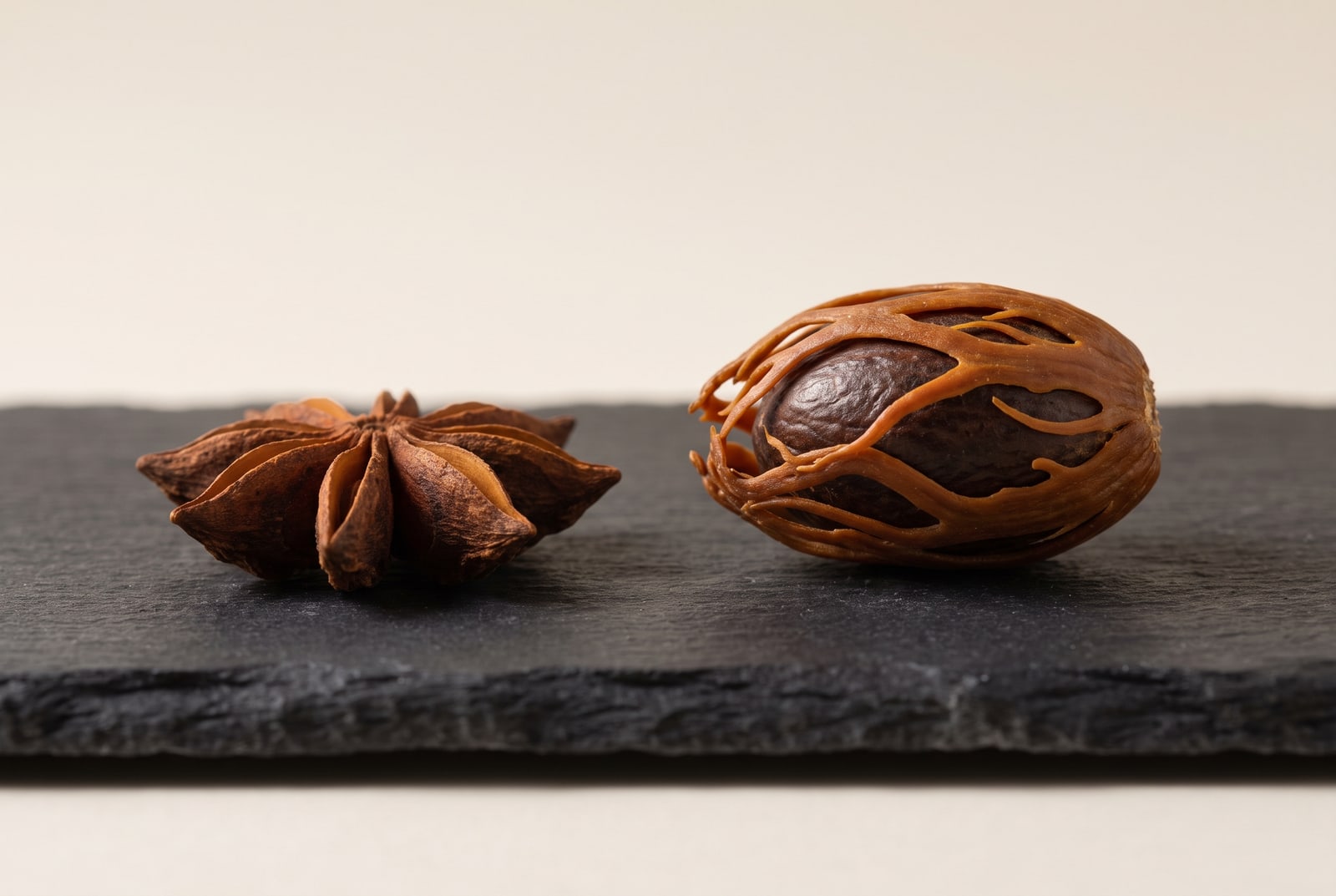
Javitri is not star anise. Javitri is mace — the lacy red-orange aril that grows around a nutmeg seed. When a nutmeg is harvested, the mace is peeled off and dried separately.
| Chakra phool (star anise) | Javitri (mace) | |
|---|---|---|
| What it is | Dried fruit of an evergreen tree | The covering around a nutmeg seed |
| Plant | Illicium verum | Myristica fragrans |
| Looks like | Hard 8-pointed brown star, 2–3 cm | Flat brittle orange-red lace |
| Tastes of | Licorice, sharp, woody | Nutmeg — warm, sweet, delicate |
| In a biryani | Whole, into the hot fat, left in | Whole or ground, warm background note |
They get confused for three reasons, all of them understandable: both are whole spices, both are a warm reddish-brown, and both turn up in exactly the same biryani and korma pots without most cooks knowing which is which.
But they taste nothing alike. Substituting one for the other does not produce a slightly different dish — it produces a dish missing a note and carrying a wrong one.
And two more things it is not
Saunf is not chakra phool. Saunf is fennel seed. The two do taste alike, and for a real reason — both get their licorice character from the same compound — but fennel is a small soft seed eaten whole, often after a meal, and star anise is a hard pod that is fished out before serving.
Karnphool is not chakra phool. Karnphool, कर्णफूल, means ear-flower and is a Hindi word for an earring. It is an easy slip, since both end in phool, and it is common enough that searching for it returns jewellery rather than spice.
What it does in an Indian kitchen
Star anise arrived in Indian cooking through Mughlai and trade routes rather than growing here, and its use reflects that. It is a north Indian, celebration-food, whole-spice ingredient.
Where it appears:
- Biryani and pulao — into hot ghee or oil at the start with the other whole spices: cinnamon, green and black cardamom, cloves, bay leaf. One or two pods for a large pot.
- Korma and Mughlai gravies — same treatment, at the start, left in.
- Garam masala blends — particularly Mughlai and Kashmiri versions. Not in every recipe.
- Chai, occasionally — a single pod in a masala chai, mostly in the north and in Kashmiri-influenced blends.
Where it does not appear: everyday tempering. There is no dal that wants star anise the way one wants jeera or rai. If a daily recipe calls for it, check that the recipe is not really a Chinese one in translation.
How much: one or two pods for a family-sized pot of biryani. Star anise is stronger than almost anything else in the whole-spice bowl, and a third pod is usually a mistake. It is meant to sit under the cardamom and cinnamon, not over them.
Buying it in an Indian grocery
Two practical notes.
Buy whole pods, not powder. Whole star anise holds its aroma for years, which suits a spice used a few times a year. Ground star anise is stale within months and is the wrong format for a biryani anyway, where the pod is supposed to come out.
Check that the species is named. This matters more for star anise than for most spices. The culinary species is Illicium verum. A second species, Illicium anisatum, is a toxic ornamental that looks close enough to pass, and it has been found adulterating loose shipments because it is cheaper. Loose, unlabelled pods from an open sack are exactly the format where that risk lives.
Whole pods, named species, sealed packet.
If the shop nearby only sells it loose from an open sack, Frontier Co-op’s organic whole star anise is a sealed one-pound bag of a single ingredient. Frontier publishes the botanical name for it — Illicium verum, from Vietnam — which is the assurance worth paying for, whatever the packet in front of you calls the spice. What the two species are and why a visual check is not enough →
Related guides
Frequently asked questions
What is star anise called in Hindi?+
Chakra phool, written चक्र फूल. It means wheel flower, which is a plain description of the eight-pointed pod. Chakri phool is the same name spelled differently and is just as common. Anasphal, अनासफल, appears in some Hindi sources. And badiyan is widely used in Hindi too, borrowed from Urdu and Persian, particularly in Mughlai cooking and in the north.
What is star anise in Urdu?+
Badiyan, written بادیان, and sometimes badian khatai. The word comes from Persian and is the standard name across Urdu, Punjabi and Pakistani cooking. It is also the source of the botanical-adjacent trade name badian that appears on some export packaging. If a recipe written in Urdu or Punjabi calls for badiyan, it means star anise.
Are star anise and javitri the same?+
No, and this is the most common mix-up in an Indian spice box. Javitri is mace, the lacy red-orange covering that grows around a nutmeg seed. Star anise is a hard eight-pointed pod from an unrelated tree. They share a shelf, a warm reddish-brown colour, and a role as whole spices in biryani and garam masala, which is why they get swapped. They taste nothing alike — javitri is warm and nutmeg-sweet, star anise is licorice-sharp.
Is chakra phool the same as saunf?+
No. Saunf is fennel seed, the small pale green seed served after meals and used in panch phoron. Chakra phool is star anise. The confusion is understandable because both taste of licorice, and both get that flavour from the same compound, anethole. But fennel is a Mediterranean herb in the carrot family and star anise is the fruit of a Chinese evergreen tree. Saunf is milder and is eaten whole; chakra phool is stronger and is removed before serving.
What is star anise used for in Indian cooking?+
Almost entirely as a whole spice in rice dishes and rich gravies. It goes into the hot oil or ghee at the start of a biryani, pulao or korma along with the other whole spices, and it is left in the pot rather than ground. It also appears in some garam masala blends, particularly Mughlai and Kashmiri ones. It is not an everyday tempering spice — you will not find it in a daily dal the way jeera or rai turn up.
What is the biryani flower?+
It is star anise, and the name is a straightforward description of where most Indian home cooks meet it. English-speaking Indian households use it because the pod looks like a flower and appears mainly in biryani. It is not a botanical term and you will not find it on scientific packaging, but it is a common enough phrase in shops and in family recipes that it is worth knowing.
Is karnphool star anise?+
No — that is a different word entirely. Karnphool, कर्णफूल, means ear-flower and is a Hindi word for an earring. It is an easy slip because both words end in phool, meaning flower, and because chakra phool is not a name most people say often. The spice is chakra phool or chakri phool. If you search for karnphool you will get jewellery.
New: Google now lets you choose which sites it shows you first. One tap lifts our spice guides in your results — nobody else's — and you can undo it any time.
More on Star Anise
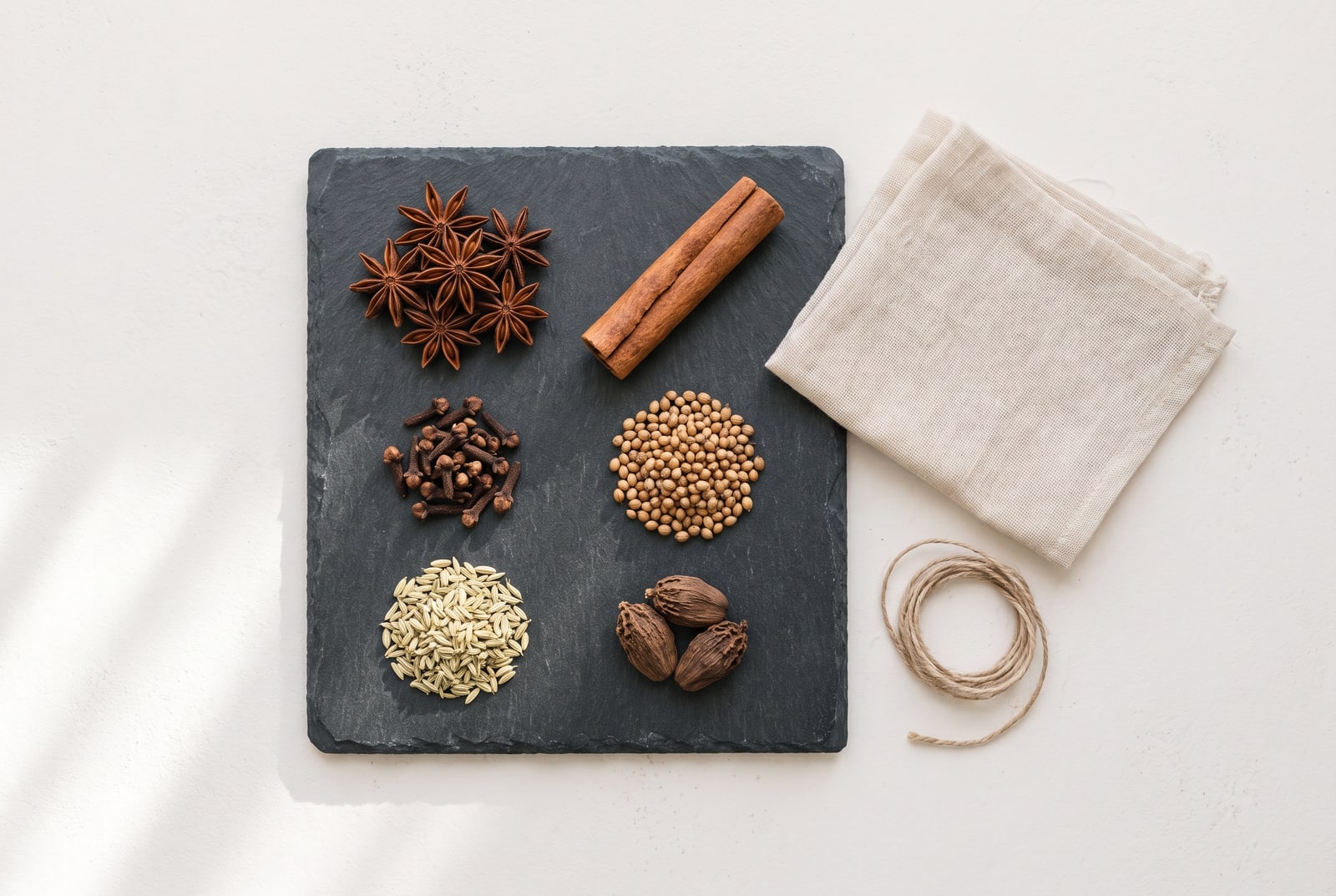
Star Anise in Pho: What It Does, and the Five Spices Beside It
What star anise actually contributes to a pho broth, how much to use, why it must be toasted first, and what each of the other five spices in the bundle is doing — a spice guide, not a broth recipe.
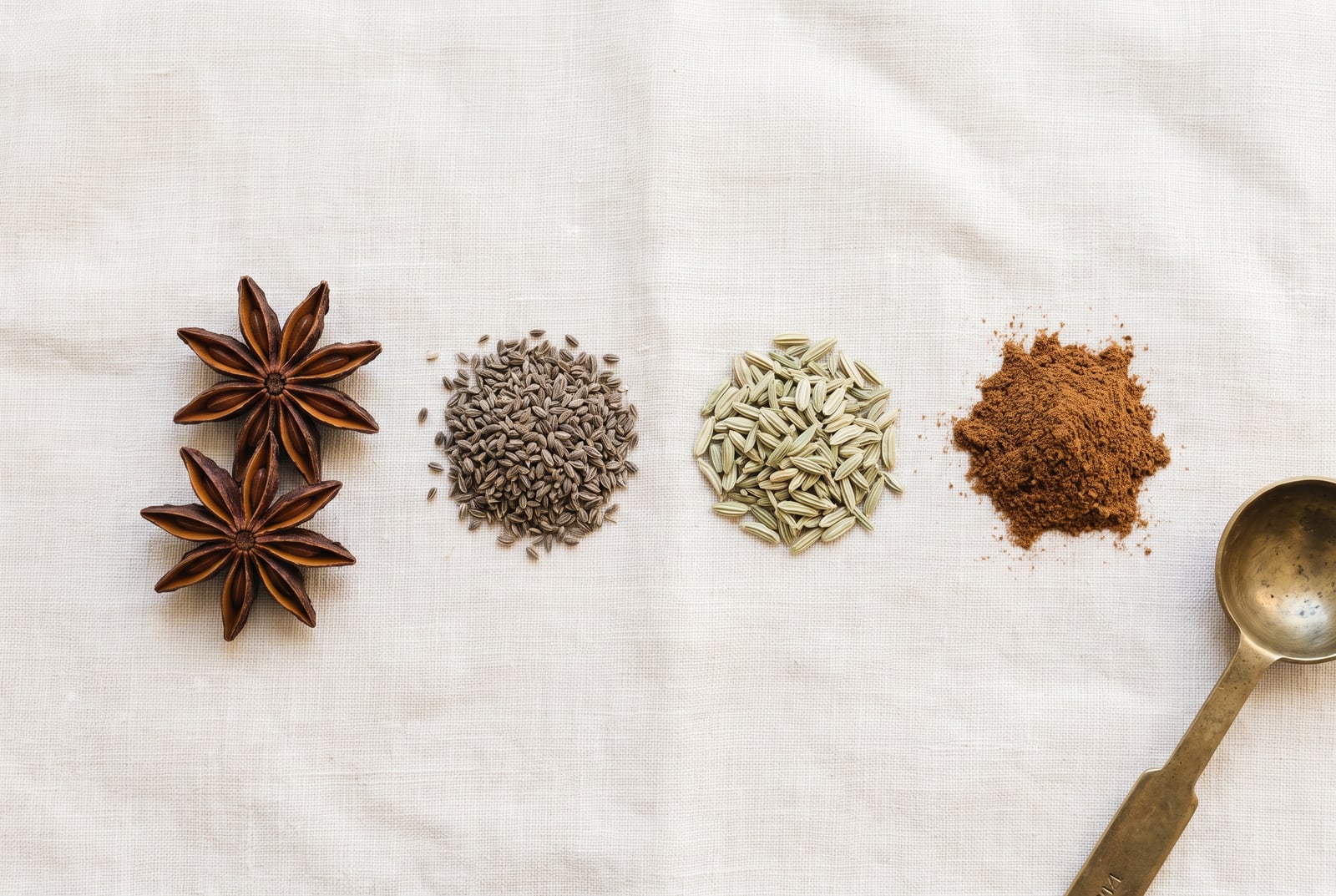
Star Anise Substitute: What to Use, by Dish
The best star anise substitutes with exact swap amounts — five-spice, aniseed, fennel, cloves and cinnamon — sorted by what you are cooking, plus the two dishes where leaving it out beats substituting.
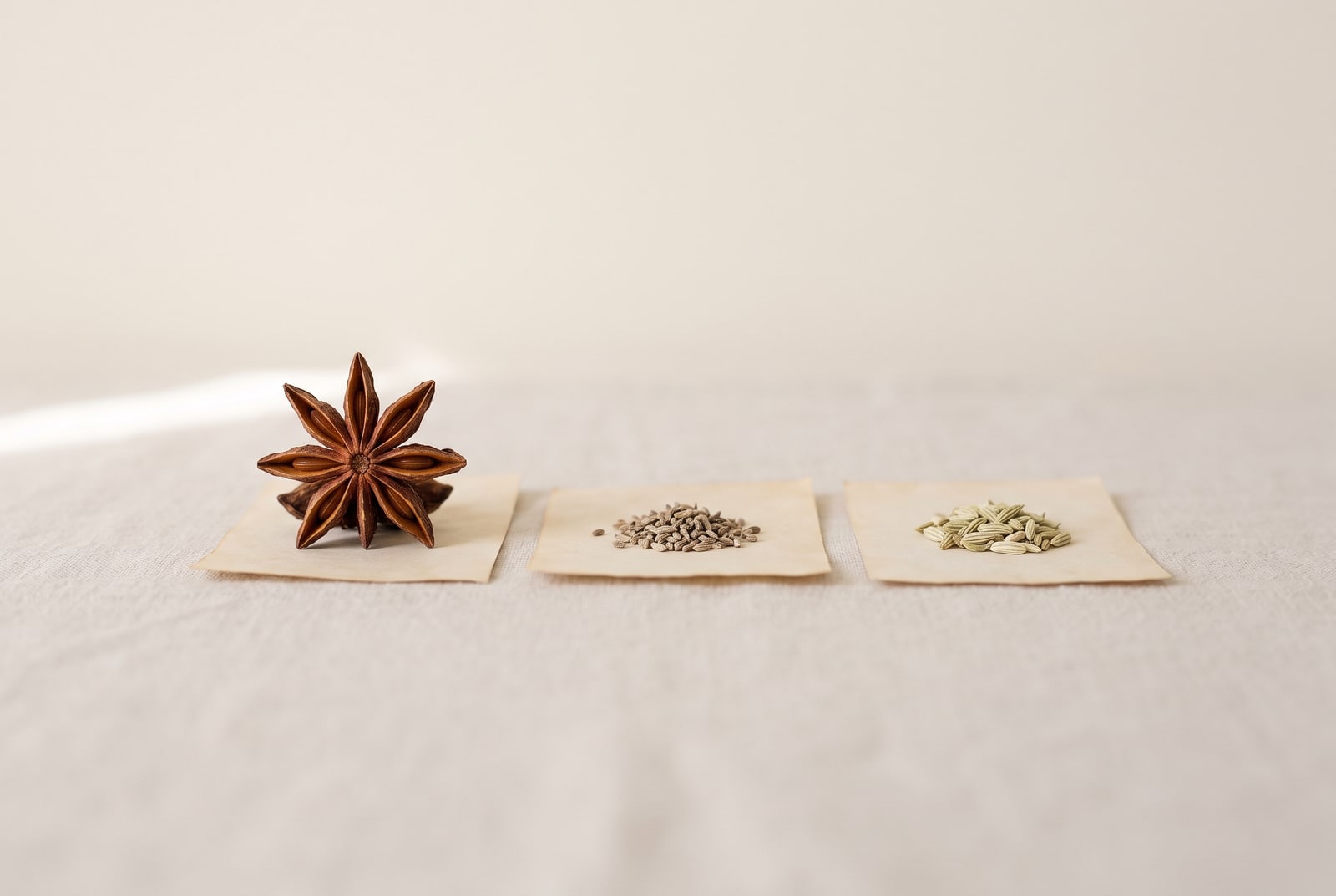
Star Anise vs Anise: Two Different Plants, and One That Is Not Food
Star anise and aniseed are unrelated plants that taste alike, and fennel is a third. What separates them, when each belongs, and how to tell culinary star anise from the toxic species that looks almost identical.