
Appliances
Automatic Roti Makers: Press, Robot, or Neither
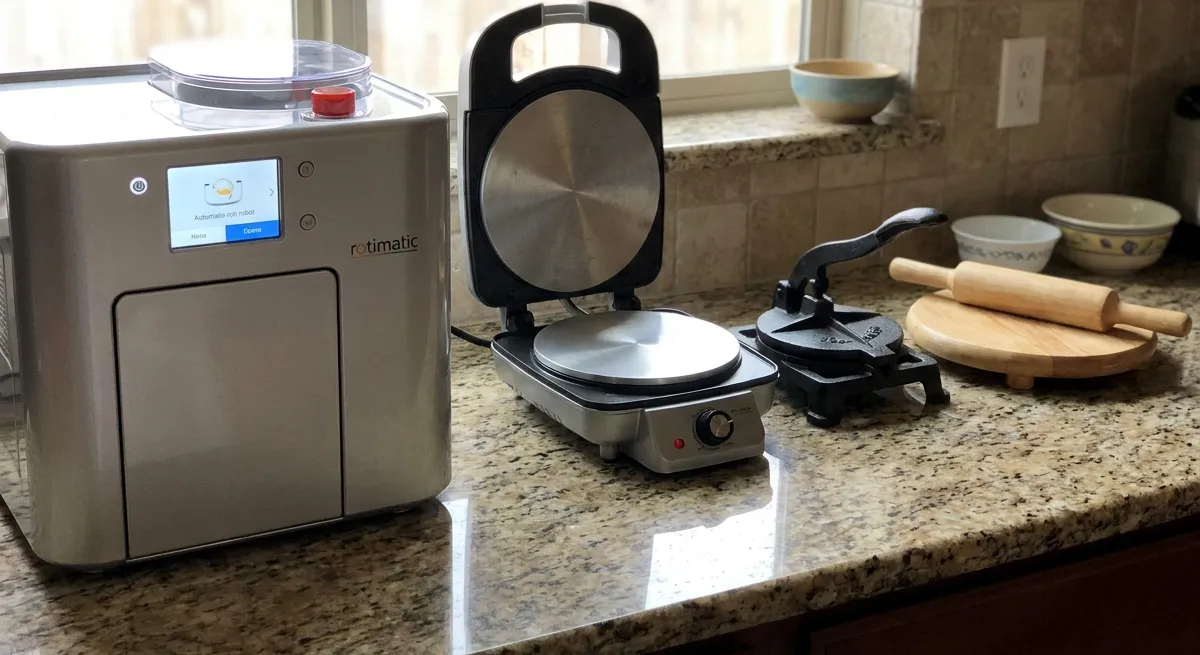
Quick answer
Two completely different machines are sold under the same name, and the prices are about twenty times apart.
- A roti press — roughly $25 to $90. A hinged pair of hot plates. You still make the dough, rest it, roll it into balls. The press flattens and part-cooks. It replaces your rolling pin and nothing else.
- A roti robot — roughly $1,400 to $2,000, and up towards $3,000 at the top of the market. You fill hoppers with flour, water and oil and press one button. It replaces the whole job.
Listings call both of them automatic. That one word, sitting over a twenty-fold price gap, is why most people end up disappointed.
The short rule: under about ten rotis a week, buy neither. Ten to thirty, buy a press. A robot only makes sense if your household eats roti most nights — at that price it has to be replacing real daily work, not occasional effort.
Search “automatic roti maker” and Google gives you a wall of shopping tiles, a few short videos, and almost nothing that answers the question people are actually asking. The real questions are sitting right there underneath, in Google’s own suggestions and in a Reddit thread near the top of the page:
Are automatic roti makers good? Has anyone mastered the art of using automatic roti makers? A roti maker that actually works? Is that worth buying?
Nobody is asking where to buy one. They are asking whether it works, and whether it is worth the money. Those are fair questions, and a product listing structurally cannot answer either.
So here is the honest version.
The two machines, and why the name is the problem
Put a $29 machine and a $1,900 machine on the same results page under the same three words, and a buyer reasonably assumes the cheap one is a budget version of the expensive one.
It is not. It is a different appliance doing a different part of the job.
| Press | Robot | |
|---|---|---|
| Typical price | $25–90 | $1,400–2,000, up to about $3,000 |
| You supply | Rested dough, divided into balls | Flour, water and oil, in hoppers |
| It does | Flattens, part-cooks | Doses, kneads, rolls, cooks, ejects |
| Per roti | A few seconds | Around a minute |
| Counter space | About a large frying pan | About a bread machine, and heavier |
| Where it lives | A cupboard | The counter — it is not a put-away appliance |
| Cleaning | Wipe two plates | Strip the dough path, every session |
| Fails when | Dough is under-rested | Flour changes, hydration is off, or it is not cleaned |
Making the dough is most of the work. Mixing, kneading, resting twenty minutes, dividing into balls — that is where the time goes. Rolling is the part people find fiddly, but it is not the part that takes long.
A press removes the fiddly part. It does not remove the long part.
If your reason for buying is “I don’t have time to make roti”, a press will not fix that. Only a robot will, and a robot is a four-figure purchase. That mismatch — between what people want and what the cheap machine does — is the most common way this goes wrong.
What a robot actually is
Rotimatic was the machine that proved the idea could work. Hoppers for flour, water and oil; it doses, mixes, kneads, rolls, cooks and drops a puffed roti out of a slot in about a minute, with nobody touching dough at any point. The current Rotimatic Next sells from the manufacturer at $1,949.
It is no longer alone. Several brands now build machines in the same category, and that competition is the genuinely good news in this market — Rotimatic was the beginning of a niche, not the whole of it. This DKKDETOHO automatic roti and chapati maker is one of them: same flour-to-finished-roti idea, one-button operation, and the listing quotes twenty flatbreads in a run, across roti, tortillas and pita. It sits in the same four-figure bracket, and it is a serious machine rather than a cheap imitation of one. As an Amazon Associate we may earn from qualifying purchases.
Two warnings that apply to the whole category, whichever brand you look at.
Be careful with prices that look too good. A flour-to-roti robot is a precision device — it has to weigh flour, dose water, knead, and roll to a consistent thickness. Listings appearing at a few hundred dollars for a “Rotimatic” are usually either a different appliance entirely or a machine that cannot hold those tolerances. If a price looks like a bargain against a $1,900 baseline, work out what has been left out before you buy.
Check the voltage on anything imported. Machines built for Indian or UK mains run on 230V. On US 120V they underheat or simply do not work, and a plug adapter changes the shape of the pins and nothing else.
Where you buy it matters more than what you pay
This is the part we would most like you to take seriously, and it is the one nobody selling you a machine will raise.
A robot is not a kettle. It has a motor, a kneading chamber, rollers working under load and heating plates, all running dough through themselves several times a week. Parts wear. Something will eventually need a service, a spare or a warranty claim — and on a four-figure appliance, who picks up the phone is a bigger question than fifty dollars of price difference.
Ask these before you buy, not after:
- How long is the warranty, and is it honoured in your country? An overseas seller’s warranty is often worth nothing where you live.
- Where do spare parts come from, and how long do they take? A machine waiting six weeks for a roller is a machine you have stopped using.
- Is there anyone who can actually repair it near you, or does it have to be shipped back?
Three ways to buy, and they are genuinely different:
A local store, if you have one. Around larger South Asian communities there are Indian grocers and appliance shops that stock these machines, and if one is within reach it is very often the best option of the three. You can watch it run before you spend the money. The voltage and the plug are already right for where you live. And there is a person, in a building, who sold it to you — which on a machine like this is worth real money the first time something goes wrong. Ask them directly what happens if it fails in month seven.
Direct from the manufacturer. Usually the clearest warranty terms, because there is no reseller in between to point at. Rotimatic, for instance, sells its own machine with a one-year warranty and a thirty-day money-back window.
An online marketplace. The widest choice, easy price comparison, and a straightforward returns window — but a returns window is not after-sales service. Once it closes you are dealing with whoever listed the product, who may be on another continent. That is fine for a $30 press. It is a real consideration on a $1,500 robot.
To be straight with you: we earn a commission if you buy through the link on this page, and we would still rather you bought the machine you can get serviced. On a cheap press the question barely matters. On a robot it is most of the decision.
What owning a robot is actually like
Read past the marketing and owners tend to report the same handful of things, and they are consistent across brands.
- When it works, it genuinely works. A hot, puffed, fresh roti with nobody touching dough is not a small thing on a weeknight, and it is the reason people keep them.
- It is not fast in a rush. About a minute each. Eight rotis is eight minutes, and there is no way to hurry it. It is hands-free time, not saved time, and those are different.
- It is loud. It is kneading and rolling; that makes noise.
- Flour matters enormously. Change atta brand and you may spend a week re-dialling settings.
- Cleaning is the real ownership cost. Not difficult, but frequent and non-negotiable — dough goes through the machine and has to come out before it dries. This is what turns daily use into weekend use and then into a cupboard.
- It is big and it stays out. Measure your counter before you decide anything else.
None of that argues against buying one. It argues for buying one for the right household, which at this price is a specific claim rather than a vague preference.
The arithmetic, done honestly
At $25 a press is an impulse. At $1,500 or more, a robot is a considered purchase — the same order of money as a good dishwasher — and it deserves the same kind of arithmetic.
Work it out for your own kitchen. Rolling and cooking eight rotis by hand is roughly half an hour. A household doing that six nights a week spends about 150 hours a year on it. Against $1,500, that is around $10 an hour in the first year, and nothing thereafter — genuinely good value, and a real amount of an evening handed back.
Now run the same sum on a household that makes roti twice a month. Twenty-four sessions a year, about twelve hours, against $1,500. It is not close.
That is the whole decision, and it is about frequency, not enthusiasm. A robot is not a treat. It is infrastructure for a household that eats roti the way other households eat rice.
The atta problem, and it is the real one
This is the part almost nothing online tells you clearly.
Indian atta is not the same flour as Western whole wheat. It is stone-ground durum wheat, milled fine, with the bran included, and it absorbs water differently and more slowly than the roller-milled whole wheat flour sold in most American supermarkets. Dough made from atta is softer and stretchier than a Western cook expects — closer to an earlobe than to bread dough.
That difference bites machines much harder than it bites hands. A person adjusts by feel without noticing. A programme runs the same numbers regardless.
Three things follow:
- Buy real atta, sold as atta or chapati flour, from an Indian grocer or the international aisle. Substituting standard whole wheat flour is where a lot of “the machine doesn’t work” reviews actually begin.
- Pick one brand and stay on it, at least while you learn the machine. Every brand hydrates slightly differently, and on a robot that is a re-tune rather than a shrug.
- Rest the dough properly — twenty minutes minimum, thirty is better. Under-rested dough springs back, presses unevenly and will not puff. Presses are especially unforgiving here, because you are compressing dough that wants to shrink.
If you take one thing from this page, take this one. Most machine complaints are dough complaints wearing a costume.
Who should not buy one
I would rather say this plainly than have you find out after the box is open.
Do not buy any roti machine if:
- You make roti less than about once a week. The cleaning and the counter space cost more than the rolling pin saves.
- You want a press to remove the effort. Making and resting dough is the effort. Only a robot removes it, and that is a four-figure purchase.
- You are buying a robot on aspiration rather than on frequency. If roti is something you would like to eat more often rather than something you already cook most nights, buy atta and a rolling pin first and see whether the habit sticks. That is a $10 experiment instead of a $1,500 one.
- You mainly want stuffed or layered breads. Paratha with a filling, or anything laminated with ghee, wants hands. A press flattens a stuffed ball into a mess, and a robot will not make one at all.
- Your kitchen has no spare counter. A robot is not a put-away appliance. A press is.
- You are buying from an overseas listing without checking voltage. See above — this one is expensive and completely avoidable.
And one more, quietly: if you have never made roti by hand, learn on a pan first. Not for purity — for diagnosis. Once you know what properly rested dough feels like and what a puff looks like, you can tell whether the machine is failing or your dough is. Without that, every problem looks like a broken appliance, and on a $1,500 machine that is an unpleasant way to find out.
Getting a good roti out of a machine
Assume you have one. Here is what actually moves the result.
Hydrate more than feels right. Roti dough should be noticeably softer than bread dough — it should take a fingerprint easily. Most first attempts are too dry, because dry dough is easier to handle and beginners drift towards it.
Rest it, then rest it again after dividing. Twenty to thirty minutes for the mass, and a few more minutes after you roll the balls. Gluten that has relaxed stays where it is put.
Press gently on a press, not hard. Force makes the middle thinner than the edge, and a thin patch is a steam vent. Steam that escapes is a roti that never puffs. Short, even pressure beats a hard squeeze every time.
Give it a moment on direct heat if it will not puff. Most presses only part-cook. Ten seconds on a hot tawa or over a gas flame, and a roti that was flat inflates. That last step is one a press cannot do and many owners do not know to add.
Stack them under a cloth. Rotis go leathery in open air within a minute. A clean tea towel over the stack keeps them soft — that is what the cloth-lined casserole in every Indian kitchen is for.
Clean it before the dough dries. Ten minutes after cooking is a wipe. The next morning it is a job. On a robot, this is the difference between owning it and storing it.
Making a machine roti taste of something
A machine gives you a consistent plain roti. Consistent and plain is a fair trade, but the flatbread was never meant to carry the flavour on its own.
Two easy things:
Ghee on the hot roti. Brushed on the moment it comes off the heat, so it melts in rather than sitting on top. This is what makes a homemade roti taste like the ones you remember, and for a lot of people it is the entire difference.
Or work the spice into the dough. A masala roti is roti dough with seasoning kneaded through it, and no machine minds:
- Cumin seed, a teaspoon per two cups of atta, lightly crushed. The most forgiving addition and the best place to start.
- Coriander powder with a pinch of salt, for something rounder and more citrusy.
- Turmeric, a quarter teaspoon, mostly for colour — it turns bitter if you overdo it.
- A pinch of red chilli, if the rest of the meal is mild.
If those already sit in a box beside your stove, you are set. If they do not, the masala dabba article covers what belongs in one and — more usefully — the mistake nearly everyone makes about where to keep it.
So: press, robot, or neither?
Neither, if roti is an occasional thing. A rolling pin and a hot tawa cost almost nothing and will always make a better roti than a machine, because your hands adjust and a programme cannot.
A press, if you make roti most weeks and dislike rolling. It is cheap, it stores in a cupboard, it wipes clean in seconds, and it does its one job well. This is the right answer for the large majority of people who search for this.
We are not pointing you at a particular press, and that is deliberate. We went through the electric presses currently on sale looking for one worth recommending, and the return rates across the whole category were high enough that we did not find a single model we would put our name to. So there is no link here. If you want a press, buy it on recent reviews and a returns policy you have actually read — and know that the alternative is a rolling pin, which costs a few dollars, never breaks, and is what most of India uses every day.
A robot, if your household eats roti most nights and standing at the tawa is the half hour you want back. Buy on cleaning and on flour tolerance, not on the feature list — and buy somewhere that will still service it in three years, from a local shop if you have one within reach. At this price those things matter more than any specification on the box.
Whichever you choose, the bread is the plate, not the meal. What goes on it is where the cooking actually is — and that starts with knowing what each spice in the pan is doing, which is what the spice guides are for, one spice at a time. The Spice Pharmacopeia volumes take the same ground further, into why these combinations work rather than only how to use them.
Buy the machine that matches the amount of bread you genuinely make. That is the whole decision.
Common questions
Are automatic roti makers good?+
It depends entirely on which machine you mean, because two very different products share the name and their prices are roughly twenty times apart. A roti press — a hinged pair of hot plates that flattens a dough ball and part-cooks it — costs about $25 to $90, works reliably, and does roughly a third of the job. A roti robot takes flour and water and returns a finished roti, costs from about $1,400 to $2,000 with the top of the market near $3,000, and does the whole job. Press owners are mostly happy with a small purchase. Robot owners split sharply between households that use one daily and households whose very expensive machine is now in a cupboard.
What is the difference between a roti maker and a roti press?+
A press flattens. You still mix the dough, rest it, divide it into balls and usually puff each roti at the end — a press replaces the rolling pin and nothing else. A robot takes over from the flour: you fill hoppers with flour, water and oil, and it doses, kneads, rests, rolls and cooks, producing finished rotis at the press of one button. Listings use the word automatic for both, which is the single biggest cause of disappointed buyers, and the price difference is enormous.
Is there an automatic roti maker machine available in the USA?+
Yes, and there is now real choice. Presses are widely stocked and inexpensive. Rotimatic proved the flour-to-roti robot could work and has sold into the US for years, and several other brands now build machines in the same category, sold on Amazon in the US. Check voltage before ordering anything from an Indian or UK listing: a 230V machine will not run properly on US 120V mains, and a plug adapter changes the shape of the pins without changing the voltage.
Which is the best automatic roti maker machine?+
There is no single best, because the answer depends on how much roti your household actually eats. Under about ten rotis a week, no machine pays for itself. Ten to thirty, a press is the sensible buy. A robot only makes sense for a household eating roti most nights of the week, because at $1,400 and up it has to replace a real, daily half hour of work to be worth the money. Compare machines on cleaning and on how they cope with your brand of atta, not on the feature list — those two decide whether it is still on the counter in six months.
Where should I buy an automatic roti maker?+
For a cheap press it hardly matters. For a robot costing four figures, buy where you can get it serviced. If there is an Indian grocer or appliance shop near you that stocks these machines, that is often the best option — you can see it run, the voltage and plug already suit your country, and there is a person to go back to when something fails. Buying direct from the manufacturer usually gives the clearest warranty terms. An online marketplace gives the widest choice and an easy returns window, but a returns window is not after-sales service: once it closes you are dealing with a seller who may be overseas. Before you pay, ask how long the warranty runs, whether it is honoured where you live, and where spare parts come from.
Do roti makers work with whole wheat atta?+
Presses do, and that is what they are designed for. Robots are the fussy ones, because they are dosing flour and water by programme rather than by feel. Atta is stone-ground durum whole wheat and it hydrates differently from the roller-milled whole wheat flour sold in most American supermarkets, so the same settings can give you dough that is too dry to shape or too wet to release. Expect a settling-in period of adjusting hydration and thickness, and once a brand of atta works for you, stay on it.
Can a roti maker make tortillas?+
Yes, and machines are often better at tortillas than at roti. A flour tortilla is thinner, does not need to puff, and is far more forgiving about pressure and timing. Most machines list tortillas, pita and chapati together for exactly this reason. If tortillas are the main use and roti is the bonus, a press will make you happy for a tiny fraction of the price of a robot.
Why does my roti not puff in a roti maker?+
Almost always the dough, not the machine. A roti puffs when steam trapped inside an evenly thin, properly sealed disc expands faster than it can escape. That needs dough with enough water in it, rested at least twenty minutes so the gluten relaxes, and even thickness with no thin patch for the steam to vent through. A press squeezed too hard makes the centre thinner than the edge, which is a vent. Rest the dough longer and press more gently before blaming the appliance.
How do you clean a roti maker?+
A press is easy: unplug it, let it cool to warm, and wipe both plates with a damp cloth. Never submerge it and never scrape the non-stick. A robot is the real ownership cost, because dough passes through a mixing chamber and rollers and has to come out before it dries. Budget time after every session and read the cleaning routine before you buy, not after — for a lot of owners, that job is exactly why an expensive machine ended up in a cupboard.
New: Google now lets you choose which sites it shows you first. One tap lifts our spice guides in your results — nobody else's — and you can undo it any time.