
Ingredients
The Masala Dabba: What Goes In It, and Where to Keep It
Quick answer
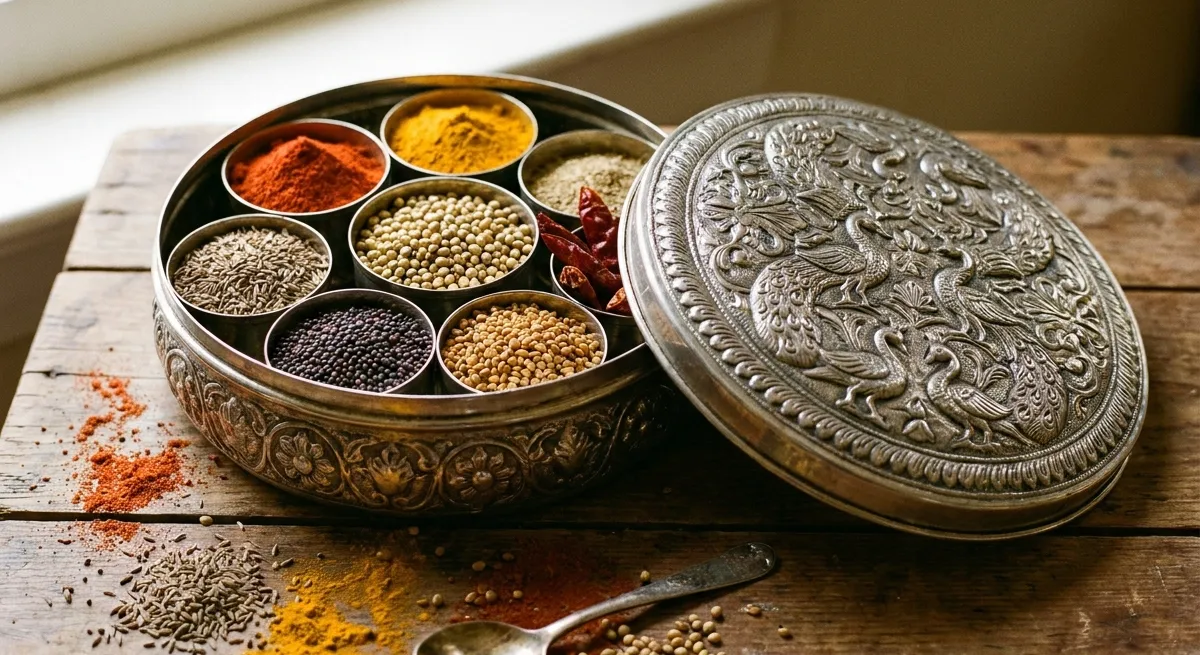
A masala dabba is a round steel box holding six or seven small open bowls — katoris — of everyday spices, with one shared spoon. You lift one lid instead of opening seven jars.
The seven most boxes start with: turmeric, cumin seeds, mustard seeds, coriander powder, red chilli powder, garam masala and salt. That is a north Indian default, not a rule.
And the thing most people get wrong: do not keep it on the counter beside the stove. That is the whole appeal of the box, and it is also the fastest way to kill what is inside it. The fix is below, and it costs about two seconds.
Searches for “masala dabba” are up roughly a third again on last year, and most of the people typing it are not from Indian households. They have seen the box on a cooking video, worked out that it explains something about how the food gets made, and want to know what goes in it.
The honest answer is more interesting than a list of seven spices.
What the box actually solves
Indian cooking is sequential in a way most Western recipes are not.
A tadka — whole spices bloomed in hot fat — runs on a clock measured in seconds. Mustard seeds pop, then you have a moment before they scorch. Cumin darkens and turns from nutty to bitter in about the same span. Somewhere in that window the next thing has to go in.
You cannot do that while opening jars.
So the dabba is not decoration and it is not really storage either. It is a staging tray. Everything that has to go into the pan inside the next thirty seconds is already open, already visible, already reachable with one hand while the other keeps the pan moving. The lid comes off, the box sits by the stove for the length of the cooking, and it goes away again.
That is also why the bowls are open inside a closed box rather than seven sealed jars. Sealing each one would defeat the point.
The seven, and why yours will be different
The set you will see quoted most often:
| Katori | What it does |
|---|---|
| Turmeric | Colour and an earthy base note. Goes in early, with the onions or just after. |
| Cumin seeds | Whole, for tadka. The nutty backbone of a huge number of everyday dishes. |
| Mustard seeds | Whole, for tadka. Pops and turns sharp-nutty. Essential in the south and west. |
| Coriander powder | Ground. Citrusy, mild, and used in volume — it is a body spice, not an accent. |
| Red chilli powder | Heat and colour. See the note below, because this one is a trap. |
| Garam masala | A finishing blend, added at the end. Not a curry powder. |
| Salt | Sits in the box because it is added at several stages, not once. |
That list is a north Indian household default, and treating it as canon is the first mistake.
A south Indian box very often carries urad dal and dried curry leaves, and leans harder on mustard than cumin. A Bengali kitchen usually keeps panch phoron, the five-seed blend, in a katori of its own. A Gujarati box will have more asafoetida in it than most north Indian cooks use in a year.
The correct seven are the seven you reach for most. Which brings us to the useful version of the question.
The red chilli powder trap
If you are shopping in a Western supermarket, the jar labelled “chili powder” is very likely not what an Indian recipe means.
American chili powder is a blend — chilli plus cumin, oregano, garlic and often salt — built for a pot of Texan chili. Indian red chilli powder is one ingredient: dried red chillies, ground. Putting the blend where the recipe wanted the single spice puts oregano in your dal.
Kashmiri chilli powder is a third thing again — very red, comparatively mild, and used when a dish needs colour more than heat. If your box has one chilli katori, that is usually the one worth making it.
There is a full breakdown in the cayenne and red chilli guide, including how to read what is actually in the jar.
How to work out your own seven
Do not fill the box on the day you buy it.
Cook normally for two weeks with every spice out on the counter. Then look at which jars have fingerprints on them. Those go in the box.
Two things happen to almost everyone who does this:
- One or two of the traditional seven barely move. Plenty of people who cook Indian food weekly use whole mustard seed twice a month. If it does not empty, it does not belong in the box.
- Something unexpected turns out to be daily. Often it is ginger-garlic paste, which does not go in a dabba at all, or a chilli you did not think of as a staple.
The rule underneath both: the box is for what you use, in the amounts you use it. It is a small box on purpose. Small amounts turn over fast, and fast turnover is the single biggest thing you can do for the flavour of ground spices.
Ground spices go in the box. Whole spices you use rarely stay in jars. A cinnamon stick, a few cardamom pods, a couple of cloves and a bay leaf are a biryani, not a Tuesday — those live on the shelf, sealed, and come out when needed. If you want to know why whole beats ground for keeping, the cardamom guide is the clearest case: whole pods hold their oils for years, ground cardamom is noticeably flatter within months.
Where to keep it — and the part almost everyone gets wrong
Here is the conflict nobody resolves out loud.
The dabba is designed to live within arm’s reach of the stove. That is its entire reason to exist.
And the area within arm’s reach of a stove is the worst place in your kitchen for ground spices. Three things degrade them, and all three peak exactly there:
- Heat. Volatile aromatic oils are what you are paying for, and warmth drives them off.
- Light. Bleaches colour and breaks the same compounds down. Turmeric fades visibly.
- Steam. The killer. Ground spices are hygroscopic — they pull moisture out of the air, and a katori that has taken on damp will cake, clump and go stale far faster than a dry one. A pan of boiling rice throws a lot of water into the air, and an open dabba beside it catches all of it.
Steam is why the box is designed to be closed and put away rather than left open on the counter, and it is the instruction most often skipped.
The honest compromise:
- Yes: a drawer, or a closed cupboard, within one step of where you actually stand and cook. You lose about two seconds.
- No: on the stovetop. On the counter directly beside a burner. On a shelf above the hob. On top of the fridge, which is warmer than people expect.
- And: close the lid and put it back when you have finished cooking, not at the end of the evening.
If you only change one thing after reading this, change this one. It matters more than which box you buy.
Steel, brass, wood or glass
Stainless steel is what most Indian kitchens use and it is the sensible default. It does not absorb odour, it does not stain permanently, it survives being dropped, and it costs the least. A clear lid is genuinely useful — you can see what is where without opening it.
Brass is the traditional and the beautiful one. It is also the most work: it tarnishes, it needs its own cleaner, and it is heavy. Buy it because you want it, not because it will cook better.
Wood looks lovely and is the one to think hardest about. Wood absorbs oil and aroma, which means a strongly scented spice can leave a ghost in the grain for the next thing in that bowl.
Glass or acrylic solves visibility completely and is the least forgiving if you drop it.
Sizes run from a compact seven-katori box up to nine and twelve. More katoris is not better. A twelve-bowl box tempts you to fill all twelve, and four of them will sit untouched for a year going stale. Seven is the traditional number because seven is roughly how many spices a person genuinely uses every day.
Refilling and cleaning
Refill each katori when it is nearly empty, not by topping it up. Pouring new turmeric onto a layer of old turmeric means the bottom of that bowl is always the oldest spice in your kitchen. Tip out what is left, wipe the katori dry, then fill it.
Ground spices are worth replacing every three to six months regardless of what is left. If a katori has not emptied in a year, that spice is in the wrong container — move it to a sealed jar on the shelf and give the katori to something you use.
Cleaning:
- Empty everything. Do not wash a katori with spice still in it.
- Warm water, mild detergent, soft sponge. Nothing abrasive on steel.
- Turmeric staining lifts with a baking soda and water paste left on for a few minutes.
- Dry every part completely. This is the step that matters. Any moisture left behind will cake the next spice and cut its life short — the same steam problem, in slow motion.
A sheet of kitchen paper cut to fit the base catches spills and makes the whole job faster.
Do you actually need one?
No. It is an organiser, not an ingredient. Nothing about Indian cooking requires one, and a labelled shelf does the same job.
What it changes is sequencing under time pressure, which is exactly where people new to this cuisine come unstuck. If you cook Indian food more than about once a week, the box earns its counter space. If you cook it now and then, it will look good and gather dust.
But if you are buying one, buy it for the right reason. The box does not make food taste better. What is in it does, and how fresh that is — which is a question about how you buy and store spices, not about how you organise them.
That is the subject of the spice guides, one spice at a time: what to look for, what the label is hiding, and how long it really keeps. The Spice Pharmacopeia volumes go further, into what each spice is actually doing once it is in the pan.
Fill the box with something worth reaching for.
Common questions
What is a masala dabba?+
A masala dabba is a round, lidded spice box used in Indian kitchens. Inside it sit six or seven small open bowls, called katoris, each holding one everyday spice, with a single small spoon shared between them. The point is one-handed access: you lift one lid, take what you need and keep stirring, instead of opening seven separate jars. Most are stainless steel, though brass, wood and glass versions all exist.
What are the 7 spices for a masala dabba?+
The most common seven are turmeric, cumin seeds, mustard seeds, coriander powder, red chilli powder, garam masala and salt. That set is a north Indian default rather than a rule. A south Indian box often carries urad dal, curry leaves and more mustard than cumin; a Bengali one usually carries panch phoron. The correct seven are the seven you reach for most in your own cooking, which is not something anyone can tell you in advance.
What should I put in my masala dabba?+
Start with what your last month of cooking actually used, not with a list. Cook from your normal recipes for two weeks with all your spices on the counter, notice which jars you keep picking up, and put those in the box. Almost everyone finds one or two of the traditional seven barely move, and one spice they never expected to need daily. Ground spices go in the box, whole spices you use rarely stay in jars.
Where should I keep my masala dabba in the kitchen?+
Near enough to the stove to reach it one-handed, but never on the stovetop, on the counter beside a burner, above the hob, or on top of the fridge. Heat, light and steam are what destroy ground spices, and all three are strongest exactly where the box is most convenient. A drawer or a closed cupboard within one step of where you stand and cook is the honest compromise, and it costs you about two seconds.
How often should I refill a masala dabba?+
Refill each katori when it is nearly empty rather than topping it up over old spice, and expect ground spices to be worth replacing every three to six months whether or not the box is empty. The box holds small amounts on purpose — that is a feature, because it forces the spices through faster than a large jar does. If a katori has not emptied in a year, that spice does not belong in the box.
How do you clean a masala dabba?+
Empty the katoris, wash them and the box in warm soapy water with a soft sponge, and dry every part completely before refilling. Complete drying is the part that matters: any moisture left in a katori will cake the next spice and shorten its life. For turmeric staining on steel, a paste of baking soda and water left on for a few minutes lifts most of it. Brass and copper boxes need their own cleaner and more frequent attention.
Do I actually need a masala dabba?+
No. It is an organiser, not an ingredient, and nothing in Indian cooking requires one. What it changes is sequencing: Indian cooking adds spices in a specific order under time pressure, and hunting through a cupboard mid-tadka is where beginners burn things. If you cook Indian food more than about once a week, the box earns its space. If you cook it occasionally, a labelled shelf does the same job.
New: Google now lets you choose which sites it shows you first. One tap lifts our spice guides in your results — nobody else's — and you can undo it any time.