
Ingredients
What Is Masala? The Words Indian Recipes Assume You Know
Quick answer
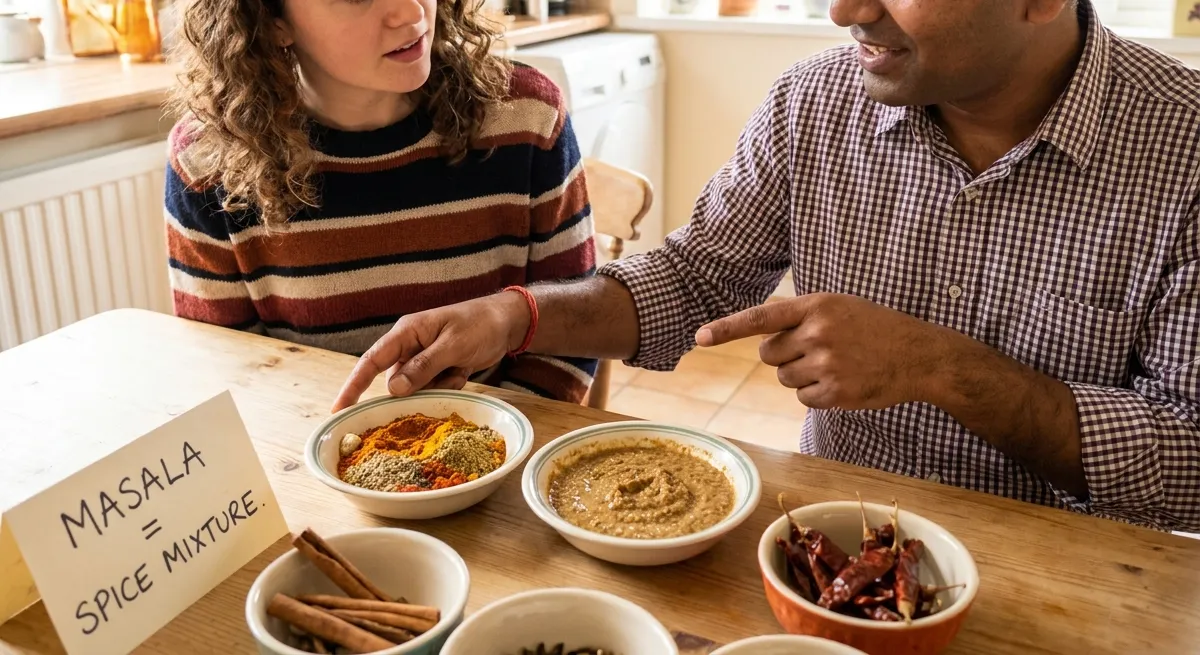
Masala means a mixture of spices. That is the whole definition.
Not a dish. Not a sauce. Not a single product. It can be a dry powder or a wet ground paste, and it can be two whole spices or twenty.
So when you see it in a dish name — masala dosa, masala chai, paneer tikka masala — it is saying there is a specific spice mixture that defines this, not naming a standard thing you can buy.
And a warning that saves confusion: garam masala means warm, not hot. Most garam masala contains no chilli at all.
Indian recipes are written for people who already know a handful of words. When they say make a tadka, or bhuna the masala, or finish with garam masala, they are not being mysterious — they assume shared vocabulary, the way a French recipe assumes you know what a roux is.
This page is that vocabulary, in plain terms.
Masala: dry and wet
The word comes into Hindi and Urdu from Arabic, where it carries the sense of ingredients or materials. In the kitchen it splits two ways.
Dry masala is ground spices blended together — garam masala, chaat masala, sambar powder. Sometimes called pisa masala, ground masala.
Wet masala is spices ground into a paste, usually with onion, ginger, garlic, chilli, tomato or coconut and a little water or oil. Much of South and West Indian cooking runs on wet masalas.
Confusingly, the cooked onion-tomato base of a North Indian gravy is also called the masala — as in bhuna masala. Context tells you which sense is meant. If someone says the masala is not ready, they mean the base in the pan, not a jar.
Khada masala means whole spices, left unground.
The blends worth knowing
| Blend | What it is | When it goes in |
|---|---|---|
| Garam masala | Warm aromatics — cardamom, clove, cinnamon, black pepper, cumin, coriander | At the end, or off the heat |
| Chaat masala | Sour and salty — dried mango powder, black salt, cumin, asafoetida | Never cooked. Sprinkled on finished food |
| Chai masala | For tea — ginger, cardamom, cinnamon, clove, pepper, fennel | Into the brewing tea |
| Tandoori masala | Marinade blend, Kashmiri chilli forward for colour | Into the yoghurt marinade |
| Sambar powder | South Indian — roasted lentils, coriander, chilli, fenugreek | Into the cooking dal |
| Panch phoron | Bengali five whole seeds — fenugreek, nigella, cumin, mustard, fennel | Whole, into hot fat |
Three of those repay a closer look.
Garam masala is the one most often misused. It is a finishing blend: its character comes from volatile aromatic compounds, and simmering it for twenty minutes evaporates exactly what you paid for. Add it in the last minute or two, or off the heat. And there is no canonical recipe — a Punjabi blend, a Kashmiri one and a Bengali one are noticeably different, and most families have their own proportions.
Chaat masala smells sulphurous when you open it. That is kala namak, black salt, and it is supposed to smell like that. It is the taste of Indian street food, and it is sour and salty rather than hot. Sprinkle it on fruit, yoghurt, chips, fried snacks — never cook it.
Panch phoron is the odd one out because it is used whole, not ground. Five seeds in equal parts, dropped into hot fat. It is Bengali cooking’s signature opening move, the way an onion-tomato base is Punjabi cooking’s.
And chicken tikka masala deserves a footnote: as a named dish it is generally credited to Britain rather than India. That does not make it bad, and it is a genuinely popular dish — but it is not the ancient recipe it is sometimes presented as.
The technique words
These four appear constantly and are rarely explained.
Tadka
Whole spices bloomed in hot fat for a few seconds.
The reason it works is chemistry: much of what spices smell and taste of is fat-soluble. Dissolve those compounds into hot fat and they spread through the entire dish. Stir the same spice into water and it stays where you put it.
The same technique has many names — chhonk and baghar in the north, phoron in Bengal, thalippu in Tamil, popu in Telugu, oggarane in Kannada. Different kitchens, one idea.
It happens at two moments:
- At the start, as the foundation of a gravy.
- Poured over at the end, most famously onto dal — fresh spices bloomed in ghee in a small pan and tipped over the finished dish so the aroma arrives at the table intact.
The window is seconds. Mustard seeds pop and then scorch. Cumin darkens, smells nutty, then turns bitter. This is why nobody walks away, and why a spice box sits within reach of the stove — though where it actually belongs is a longer argument.
Bhuna
Frying the base until the fat separates.
From a Hindi word meaning to roast or fry. You keep cooking the onion, ginger, garlic, tomato and ground spices — stirring, scraping, splashing in water when it catches — until oil comes out of the mixture and pools around the edge of the pan.
That visible oil is the doneness signal: it means the water has gone and the raw taste of the ingredients has cooked out. Most Western recipes never mention it, and its absence is the usual reason a home-made gravy tastes thin. The full method is here.
Dum
Cooking sealed, so the steam cannot escape.
Traditionally the lid is sealed onto the pot with a rope of dough. The food cooks in its own moisture and the aromas from whole spices circulate rather than escaping. Most associated with biryani. The full term, dum pukht, comes from Persian.
Tandoori
Not a masala but a method: cooking with fierce dry heat in a clay oven. No oil, no liquid. It is why tandoori food behaves nothing like fried food, and why an air fryer turns out to be a reasonable stand-in when a frying pan is not.
The working spice list
Not everything sold as Indian, but what actually earns shelf space, grouped by the job it does.
Whole seeds, for tempering Cumin · black mustard · fenugreek (methi) · nigella (kalonji) · fennel (saunf) · ajwain (carom)
Warm aromatics, mostly whole Green cardamom · black cardamom · clove · cinnamon or cassia · star anise · bay leaf (tej patta)
Ground body spices — used by the spoonful Coriander · ground cumin · turmeric
Heat Red chilli powder, including mild Kashmiri chilli used mainly for colour · black pepper
Sour Amchur (dried green mango) · tamarind · anardana (dried pomegranate seed)
The distinctive ones Asafoetida (hing) · curry leaves · kasuri methi (dried fenugreek leaf) · saffron · rose water
If you are starting from nothing, six will do: turmeric, ground coriander, cumin seed, red chilli powder, mustard seed, garam masala. Add ginger and garlic — not spices, but they work like them here.
Do not buy twenty jars at once. Ground spices fade within months, and twenty jars bought together become twenty stale jars bought together. Add them as specific dishes ask for them.
Two things about heat
“Masala” does not mean hot. It means spiced. A masala dosa is a dosa with a potato filling; nothing about the word promises chilli. This trips up a lot of people whose first exposure to Indian food was a restaurant menu ordered by heat level.
Chilli is one spice among many, and in most home cooking it is not the loudest. The building blocks of a North Indian gravy are onion, tomato, coriander and turmeric. The chilli is an adjustment at the end, not the foundation.
Ground or whole
The single most useful buying rule in this cuisine.
Whole spices keep for about a year. Their aromatic oils are locked inside an intact seed or pod.
Ground spices are noticeably flat within six months, because grinding exposes enormous surface area and those oils evaporate. A jar of ground cardamom that has been open two years is a jar of brown dust.
So: buy whole where you will use it whole — cumin and mustard for tempering, cardamom and cloves for rice and sweets. Buy ground where you use it in volume — coriander, turmeric — and buy the size you will finish.
Blends fade fastest of all, because they are ground by definition. A garam masala that has been in the cupboard for two years is contributing nothing but colour, and it is the most common hidden reason a carefully cooked dish tastes of very little.
Where each of these goes next
Every word above is a doorway into one spice or one technique.
The spice guides take them one at a time — what each spice is actually doing in a dish, how to tell a fresh one from a dead one, what the supermarket label is not telling you, and which substitutions genuinely work. The Spice Pharmacopeia volumes go further, into why particular combinations behave the way they do once they are in the pan.
Start with how a gravy is built. Everything on this page is vocabulary for that one process.
Common questions
What does masala mean?+
Masala simply means a mixture of spices. The word comes into Hindi and Urdu from Arabic, where it carries the sense of ingredients or materials, and in cooking it covers both dry ground blends and wet ground pastes. It is not a dish, a sauce or a single recipe. When it appears in a dish name — masala dosa, masala chai, paneer tikka masala — it is telling you that a particular spice mixture is the defining element, not naming a standard product.
Is masala the same as curry powder?+
No. Curry powder is a single British blend invented to approximate a whole cuisine in one jar, and it tastes the same in everything you use it in. Masala is a general word for any spice mixture, and Indian cooking uses many different ones for different purposes — a warming finishing blend, a sour street-food sprinkle, a tea blend, a regional gravy base. There is no jar labelled simply masala, because the word on its own does not name a product.
What is garam masala, and is it spicy?+
Garam masala is a finishing blend of warm aromatic spices, typically cardamom, clove, cinnamon, black pepper, cumin and coriander, sometimes with nutmeg, mace or bay. Garam means warm or hot, but in the sense of warming the body in Ayurvedic thinking, not in the sense of chilli heat. Most garam masala contains no chilli at all. It is added at the end of cooking or off the heat, because its aroma is volatile and prolonged simmering drives it off.
What is tadka?+
Tadka is the technique of blooming whole spices in hot fat for a few seconds so their fat-soluble aromatics dissolve into the oil and then disperse through the whole dish. It goes by different names in different languages — chhonk and baghar in the north, phoron in Bengal, thalippu in Tamil, popu in Telugu — and it appears at two points in cooking: at the start, as the foundation of a gravy, or poured over a finished dish such as dal at the last second. The window is seconds, which is why nobody walks away during it.
What is the difference between garam masala and chaat masala?+
They do opposite jobs. Garam masala is warm and aromatic, built on cardamom, clove and cinnamon, and it is added at the end of cooking. Chaat masala is sour and salty, built on dried green mango powder and black salt, and it is never cooked at all — it is sprinkled over finished food, fruit, yoghurt or fried snacks. Black salt gives it a distinctly sulphurous smell that surprises people the first time they open the jar; that is correct, not spoilage.
What is bhuna?+
Bhuna comes from a Hindi word meaning to roast or fry, and it names the stage where you keep frying the onion, tomato and spice base until the raw flavours cook out and the fat visibly separates from the solids. The finished base is called bhuna masala. It is the most important technique in North Indian gravy cooking and the one most Western recipes leave out entirely.
What is dum cooking?+
Dum means cooking slowly in a sealed pot so that the steam cannot escape and the food cooks in its own moisture and aroma. Traditionally the lid is sealed to the pot with a rope of dough. It is most associated with biryani, where it produces separated grains and lets the aromas from whole spices work through the rice. The full name of the technique, dum pukht, comes from Persian.
What spices do I actually need to start?+
Six will cover most everyday North Indian cooking: turmeric, ground coriander, cumin seed, red chilli powder, mustard seed and garam masala. Add ginger and garlic, which are not spices but behave like them in this cuisine. Everything else is a refinement you can add as specific dishes call for it, and buying twenty jars at once mostly produces twenty stale jars, because ground spices fade within months.
New: Google now lets you choose which sites it shows you first. One tap lifts our spice guides in your results — nobody else's — and you can undo it any time.